11.1 Mixture models
Mixture models naturally arise in situations where a sample consists of draws from different subpopulations (clusters) that cannot be easily distinguished based on observable characteristics. However, performing inference on specific identified subpopulations can be misleading if the assumed distribution for each cluster is misspecified.
Even when distinct subpopulations do not exist, finite and infinite mixture models provide a useful framework for semi-parametric inference. They effectively approximate distributions with skewness, excess kurtosis, and multimodality, making them useful for modeling stochastic errors.
In addition, mixture models help capture unobserved heterogeneity. That is, as data modelers, we may observe individuals with identical sets of observable variables but entirely different response variables. These differences cannot be explained solely by sampling variability; rather, they suggest the presence of an unobserved underlying process, independent of the observable features, that accounts for this pattern.
11.1.1 Finite Gaussian mixtures
A finite Gaussian mixture model for regression with \(H\) known components assumes that a sample
\(\boldsymbol{y}=\left[y_1 \ y_2 \ \dots \ y_N\right]^{\top}\) consists of observations \(y_i\),
for \(i=1,2,\dots,N\), where each \(y_i\) is generated from one of the \(H\) components,
\(h=1,2,\dots,H\), conditional on the regressors \(\boldsymbol{x}_i\). Specifically, we assume
\[
y_i \mid \boldsymbol{x}_i \sim N(\boldsymbol{x}_i^{\top}\boldsymbol{\beta}_h, \sigma_h^2).
\]
Thus, the sampling distribution of \(y_i\) is given by
\[
p(y_i \mid \{\lambda_h, \boldsymbol{\beta}_h, \sigma_h^2\}_{h=1}^H, \boldsymbol{x}_i) =
\sum_{h=1}^H \lambda_h \phi(y_i \mid \boldsymbol{x}_i^{\top}\boldsymbol{\beta}_h, \sigma_h^2),
\]
where \(\phi(y_i \mid \boldsymbol{x}_i^{\top}\boldsymbol{\beta}_h, \sigma_h^2)\) is the Gaussian density with mean \(\boldsymbol{x}_i^{\top}\boldsymbol{\beta}_h\) and variance \(\sigma_h^2\), \(0 < \lambda_h < 1\) represents the proportion of the population belonging to subpopulation \(h\), and the weights satisfy \(\sum_{h=1}^H \lambda_h = 1\).
Then, we allow cross-sectional units to differ according to unobserved clusters (subpopulations) that exhibit homogeneous behavior within each cluster.
To model a finite Gaussian mixture, we introduce an individual cluster indicator or latent class \(\psi_{ih}\) such that
\[
\psi_{ih}=
\begin{cases}
1, & \text{if the } i\text{-th unit is drawn from the } h\text{-th cluster}, \\
0, & \text{otherwise}.
\end{cases}
\]
Thus, \(P(\psi_{ih}=1) = \lambda_h\) for all clusters \(h=1,2,\dots,H\) and units \(i=1,2,\dots,N\). Note that a high probability of individuals belonging to the same cluster suggests that these clusters capture similar sources of unobserved heterogeneity.
This setting implies that
\[
\boldsymbol{\psi}_i = [\psi_{i1} \ \psi_{i2} \ \dots \ \psi_{iH}]^{\top} \sim \text{Categorical}(\boldsymbol{\lambda}),
\]
where \(\boldsymbol{\lambda} = [\lambda_1 \ \lambda_2 \ \dots \ \lambda_H]^{\top}\) represents the event probabilities.
We know from Subsection 3.2 that the Dirichlet prior distribution is conjugate to the multinomial distribution, where the categorical distribution is a special case in which the number of trials is one. Thus, we assume that
\[
\pi(\boldsymbol{\lambda}) \sim \text{Dir}(\boldsymbol{\alpha}_0),
\]
where \(\boldsymbol{\alpha}_0 = [\alpha_{10} \ \alpha_{20} \ \dots \ \alpha_{H0}]^{\top}\), \(\alpha_{h0}=1/H\) is recommended by Andrew Gelman et al. (2021).
Observe that we are using a hierarchical structure, as we specify a prior on \(\boldsymbol{\lambda}\), which serves as the hyperparameter for the cluster indicators. In addition, we can assume conjugate families for the location and scale parameters to facilitate computation, that is, \(\boldsymbol \beta_h\sim N(\boldsymbol{\beta}_{h0},\boldsymbol{B}_{h0})\) and \(\sigma_h^2\sim IG(\alpha_{h0}/2,\delta_{h0}/2)\).
This setting allows to obtain standard conditional posterior distributions: \[\boldsymbol{\beta}_{h}\sim N(\boldsymbol{\beta}_{hn},\boldsymbol{B}_{hn}),\] where \(\boldsymbol{B}_{hn}=(\boldsymbol{B}_{h0}^{-1}+\sigma_h^{-2}\sum_{\left\{i: \psi_{ih}=1\right\}}\boldsymbol{x}_i\boldsymbol{x}_i^{\top})^{-1}\) and \(\boldsymbol{\beta}_{hn}=\boldsymbol{B}_{hn}(\boldsymbol{B}_{h0}^{-1}\boldsymbol{\beta}_{h0}+\sigma_h^{-2}\sum_{\left\{i: \psi_{ih}=1\right\}}\boldsymbol{x}_iy_i)\). \[\sigma_h^2\sim IG(\alpha_{hn}/2,\delta_{hn}/2),\]
where \(\alpha_{hn}=\alpha_{h0}+N_h\), \(\delta_{hn}=\delta_{h0}+\sum_{\left\{i: \psi_{ih}=1\right\}}(y_i-\boldsymbol{x}_i^{\top}\boldsymbol{\beta}_h)^2\), and \(N_h\) is the number of units in cluster \(h\).
\[\boldsymbol{\lambda}\sim \text{Dir}(\boldsymbol{\alpha}_n),\]
where \(\boldsymbol{\alpha}_n=[\alpha_{1n} \ \alpha_{2n} \ \dots \ \alpha_{Hn}]^{\top}\), and \(\alpha_{hn}=\alpha_{h0}+N_h\).
\[\boldsymbol{\psi}_{in}\sim \text{Categorical}(\boldsymbol{\lambda}_n),\] where \(P(\psi_{ih}=1)=\frac{\lambda_{h}\phi(y_i \mid \boldsymbol{x}_i^{\top}\boldsymbol{\beta}_h,\sigma_h^2)}{\sum_{j=1}^H\lambda_{j}\phi(y_i \mid \boldsymbol{x}_i^{\top}\boldsymbol{\beta}_j,\sigma_j^2)}\).
In general, it is always safer to perform inference in mixture models using informative priors, as non-informative priors may have unintended consequences on posterior inference. One way to facilitate prior elicitation is to work with standardized data, as this removes dependence on measurement units. Another useful approach is to specify the model in log-log form so that the coefficients can be interpreted as elasticities or semi-elasticities. As always in Bayesian inference, it makes sense to perform a sensitivity analysis with respect to the hyperparameters.
Mixture models have the label-switching identification problem, meaning they are nonidentifiable because the distribution remains unchanged if the group labels are permuted (Van Hasselt 2011). For instance, a mixture model with two components can be characterized by \(\left\{\lambda_1,\boldsymbol{\beta}_1,\sigma_1^2\right\}\) for the first cluster and \(\left\{1-\lambda_1,\boldsymbol{\beta}_2,\sigma_2^2\right\}\) for the second. However, an alternative characterization is \(\left\{1-\lambda_1,\boldsymbol{\beta}_2,\sigma_2^2\right\}\) for cluster 1 and \(\left\{\lambda_1,\boldsymbol{\beta}_1,\sigma_1^2\right\}\) for cluster 2. This parametrization yields exactly the same likelihood as the first one, meaning any permutation of the cluster labels leaves the likelihood unchanged. Consequently, the posterior draws of each component-specific parameter target the same distribution.
Label switching may pose challenges when performing inference on specific mixture components, such as in the regression analysis presented here. However, it is not an issue when inference on specific components is unnecessary, as in cases where mixtures are used to model stochastic errors in semi-parametric settings. In the former case, post-processing strategies can mitigate the issue, such as random permutation of latent classes (see the simulation exercise below, Andrew Gelman et al. (2021) and Algorithm 3.5 in Frühwirth-Schnatter (2006)).
A semi-parametric regression imposes a specific structure in part of the model and uses flexible assumptions in another part, for instance \[\begin{align*} y_i&=\boldsymbol{x}_i^{\top}\boldsymbol{\beta}+\mu_i,\\ p(\mu_i \mid \left\{\lambda_h,\mu_h,\sigma_h^2\right\}_{h=1}^H)&=\sum_{h=1}^H\lambda_h\phi(\mu_i\mid \mu_h,\sigma_h^2). \end{align*}\]
Thus, the distribution of the stochastic error is a finite Gaussian mixture. Note that the mean of the stochastic error is not equal to zero; consequently, the intercept in the regression should be removed, as these two parameters are not separately identifiable (Van Hasselt 2011). Additionally, this approach allows for multiple modes and asymmetric distributions of the stochastic errors, providing greater flexibility.
We can use a Gibbs sampling algorithm in this semi-parametric specification if we assume conjugate families. The difference from the previous setting is that we have the same slope parameters; thus, \(\boldsymbol{\beta} \sim N(\boldsymbol{\beta}_{0},\boldsymbol{B}_{0})\). Additionally, we must specify the prior distribution for the means of the stochastic errors, given by \(\mu_h \sim N(\mu_{h0},\sigma^2_{h0})\). Then, the posterior distributions are:
\[\boldsymbol{\beta}\sim N(\boldsymbol{\beta}_{n},\boldsymbol{B}_{n}),\] where \(\boldsymbol{B}_{n}=(\boldsymbol{B}_{0}^{-1}+\sum_{h=1}^H\sum_{\left\{i: \psi_{ih}=1\right\}}\sigma_h^{-2}\boldsymbol{x}_i\boldsymbol{x}_i^{\top})^{-1}\) and \(\boldsymbol{\beta}_{n}=\boldsymbol{B}_{n}(\boldsymbol{B}_{0}^{-1}\boldsymbol{\beta}_{0}+\sum_{h=1}^H\sum_{\left\{i: \psi_{ih}=1\right\}}\sigma_h^{-2}\boldsymbol{x}_i(y_i-\mu_h))\). \[\sigma_h^2\sim IG(\alpha_{hn}/2,\delta_{hn}/2),\]
where \(\alpha_{hn}=\alpha_{h0}+N_h\), \(\delta_{hn}=\delta_{h0}+\sum_{\left\{i: \psi_{ih}=1\right\}}(y_i-\mu_h-\boldsymbol{x}_i^{\top}\boldsymbol{\beta}_h)^2\), and \(N_h\) is the number of units in cluster \(h\).
\[\mu_h\sim N(\mu_{hn},\sigma_{hn}^2),\]
where \(\sigma_{hn}^2=\left(\frac{1}{\sigma_{h0}^{2}}+\frac{N_h}{\sigma_{h}^2}\right)^{-1}\) and \(\mu_{hn}=\sigma_{hn}^2\left(\frac{\mu_{h0}}{\sigma_{\mu0}^2}+\frac{\sum_{\left\{i:\psi_{ih}=1\right\}} (y_i-\boldsymbol{x}_i\boldsymbol{\beta})}{\sigma_h^2}\right)\).
\[\boldsymbol{\lambda}\sim \text{Dir}(\boldsymbol{\alpha}_n),\]
where \(\boldsymbol{\alpha}_n=[\alpha_{1n} \ \alpha_{2n} \ \dots \ \alpha_{Hn}]^{\top}\), and \(\alpha_{hn}=\alpha_{h0}+N_h\).
\[\boldsymbol{\psi}_{in}\sim \text{Categorical}(\boldsymbol{\lambda}_n),\] where \(P(\psi_{ih}=1)=\frac{\lambda_{h}\phi(y_i\mid \mu_h+\boldsymbol{x}_i^{\top}\boldsymbol{\beta},\sigma_h^2)}{\sum_{j=1}^H\lambda_{j}\phi(y_i\mid \mu_j+\boldsymbol{x}_i^{\top}\boldsymbol{\beta},\sigma_j^2)}\).
A potential limitation of finite mixture models is the need to specify the number of components in advance. One approach is to estimate the model for different values of \(H\) and then compute the marginal likelihood to select the model best supported by the data. However, this procedure can be tedious. A simpler strategy is to set \(H\) large enough (e.g., 10 components), assign \(\alpha_{h0} = 1/H\), and perform an initial run of the algorithm. If we are not interested in the specific composition of clusters, this approach is sufficient. Otherwise, the posterior distribution of \(H\) can be obtained by tracking the number of nonempty clusters in each iteration. In a second run, \(H\) can then be fixed at the mode of this posterior distribution.
However, the previous approaches ultimately fix the number of components. Consequently, finite mixtures cannot be considered a non-parametric method (Peter E. Rossi 2014), as they lack an automatic mechanism to increase \(H\) as the sample size grows. An alternative is to avoid pre-specifying the number of components altogether by using a Dirichlet process mixture (DPM). This is the topic of the next section.
Example: Simulation exercises
First, let’s illustrate the label-switching issue using a simple model without regressors, assuming the same known variance. Consider the following distribution:
\[p(y_i) = 0.75 \phi(y_i \mid \beta_{01},1^2) + 0.25 \phi(y_i \mid \beta_{02},1^2), \quad i = 1,2,\dots,500.\]
Initially, we set \(\beta_{01} = 0.5\) and \(\beta_{02} = 2.5\). We perform 1,000 MCMC iterations, with a burn-in period of 500 and a thinning factor of 2. The following code demonstrates how to implement the Gibbs sampler using a prior normal distribution with mean 0 and variance 10, with the hyperparameters of the Dirichlet distribution set to \(1/2\).
rm(list = ls()); set.seed(010101); library(ggplot2)
# Simulate data from a 2-component mixture model
n <- 500
z <- rbinom(n, 1, 0.75)  # Latent class indicator
y <- ifelse(z == 1, rnorm(n, 0.5, 1), rnorm(n, 2.5, 1))
data <- data.frame(y)
# Plot
ggplot(data, aes(x = y)) +
geom_density(fill = "blue", alpha = 0.3) + labs(title = "Density Plot", x = "y", y = "Density") + theme_minimal()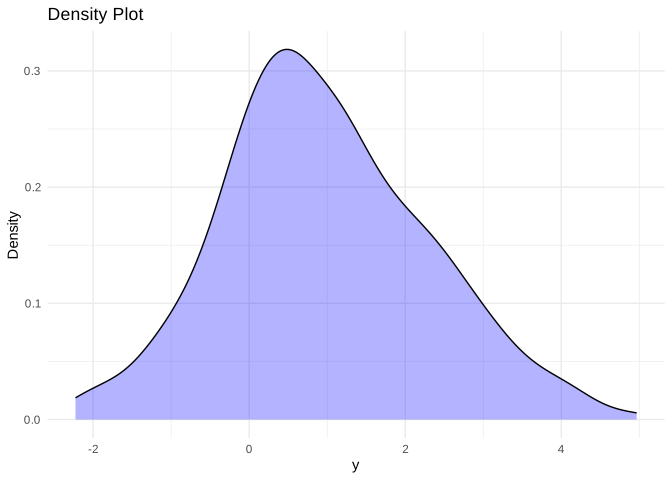
# Hyperparameters
mu0 <- 0; sig2mu0 <- 10; H <- 2; a0h <- rep(1/H, H)
# MCMC parameters
mcmc <- 1000; burnin <- 500; tot <- mcmc + burnin; thin <- 2
# Gibbs sampling functions
Postmu <- function(yh){
    Nh <- length(yh)
    sig2mu <- (1/sig2mu0 + Nh)^(-1)
    mun <- sig2mu*(mu0/sig2mu0 + sum(yh))
    mu <- rnorm(1, mun, sig2mu^0.5)
    return(mu)
}
PostPsi <- matrix(NA, tot, n); PostMu <- matrix(NA, tot, H)
PostLambda <- rep(NA, tot)
Id1 <- which(y <= 1) # 1 is from inspection of the density plot of y
Id2 <- which(y > 1)
N1 <- length(Id1); N2 <- length(Id2)
Lambda <- c(N1/n, N2/n)
MU <- c(mean(y[Id1]), mean(y[Id2])); Psi <- rep(NA, n)
pb <- txtProgressBar(min = 0, max = tot, style = 3)
## | | | 0%for(s in 1:tot){
for(i in 1:n){
lambdai <- NULL
for(h in 1:H){
lambdaih <- Lambda[h]*dnorm(y[i], MU[h], 1)
lambdai <- c(lambdai, lambdaih)
}
Psi[i] <- sample(1:H, 1, prob = lambdai)
}
PostPsi[s, ] <- Psi
for(h in 1:H){
idh <- which(Psi == h); MU[h] <- Postmu(yh = y[idh])
}
PostMu[s,] <- MU;
Lambda <- sort(MCMCpack::rdirichlet(1, a0h + table(Psi)), decreasing = TRUE)
PostLambda[s] <- Lambda[1]
setTxtProgressBar(pb, s)
}## | | | 1% | |= | 1% | |= | 2% | |== | 2% | |== | 3% | |== | 4% | |=== | 4% | |=== | 5% | |==== | 5% | |==== | 6% | |===== | 6% | |===== | 7% | |===== | 8% | |====== | 8% | |====== | 9% | |======= | 9% | |======= | 10% | |======= | 11% | |======== | 11% | |======== | 12% | |========= | 12% | |========= | 13% | |========= | 14% | |========== | 14% | |========== | 15% | |=========== | 15% | |=========== | 16% | |============ | 16% | |============ | 17% | |============ | 18% | |============= | 18% | |============= | 19% | |============== | 19% | |============== | 20% | |============== | 21% | |=============== | 21% | |=============== | 22% | |================ | 22% | |================ | 23% | |================ | 24% | |================= | 24% | |================= | 25% | |================== | 25% | |================== | 26% | |=================== | 26% | |=================== | 27% | |=================== | 28% | |==================== | 28% | |==================== | 29% | |===================== | 29% | |===================== | 30% | |===================== | 31% | |====================== | 31% | |====================== | 32% | |======================= | 32% | |======================= | 33% | |======================= | 34% | |======================== | 34% | |======================== | 35% | |========================= | 35% | |========================= | 36% | |========================== | 36% | |========================== | 37% | |========================== | 38% | |=========================== | 38% | |=========================== | 39% | |============================ | 39% | |============================ | 40% | |============================ | 41% | |============================= | 41% | |============================= | 42% | |============================== | 42% | |============================== | 43% | |============================== | 44% | |=============================== | 44% | |=============================== | 45% | |================================ | 45% | |================================ | 46% | |================================= | 46% | |================================= | 47% | |================================= | 48% | |================================== | 48% | |================================== | 49% | |=================================== | 49% | |=================================== | 50% | |=================================== | 51% | |==================================== | 51% | |==================================== | 52% | |===================================== | 52% | |===================================== | 53% | |===================================== | 54% | |====================================== | 54% | |====================================== | 55% | |======================================= | 55% | |======================================= | 56% | |======================================== | 56% | |======================================== | 57% | |======================================== | 58% | |========================================= | 58% | |========================================= | 59% | |========================================== | 59% | |========================================== | 60% | |========================================== | 61% | |=========================================== | 61% | |=========================================== | 62% | |============================================ | 62% | |============================================ | 63% | |============================================ | 64% | |============================================= | 64% | |============================================= | 65% | |============================================== | 65% | |============================================== | 66% | |=============================================== | 66% | |=============================================== | 67% | |=============================================== | 68% | |================================================ | 68% | |================================================ | 69% | |================================================= | 69% | |================================================= | 70% | |================================================= | 71% | |================================================== | 71% | |================================================== | 72% | |=================================================== | 72% | |=================================================== | 73% | |=================================================== | 74% | |==================================================== | 74% | |==================================================== | 75% | |===================================================== | 75% | |===================================================== | 76% | |====================================================== | 76% | |====================================================== | 77% | |====================================================== | 78% | |======================================================= | 78% | |======================================================= | 79% | |======================================================== | 79% | |======================================================== | 80% | |======================================================== | 81% | |========================================================= | 81% | |========================================================= | 82% | |========================================================== | 82% | |========================================================== | 83% | |========================================================== | 84% | |=========================================================== | 84% | |=========================================================== | 85% | |============================================================ | 85% | |============================================================ | 86% | |============================================================= | 86% | |============================================================= | 87% | |============================================================= | 88% | |============================================================== | 88% | |============================================================== | 89% | |=============================================================== | 89% | |=============================================================== | 90% | |=============================================================== | 91% | |================================================================ | 91% | |================================================================ | 92% | |================================================================= | 92% | |================================================================= | 93% | |================================================================= | 94% | |================================================================== | 94% | |================================================================== | 95% | |=================================================================== | 95% | |=================================================================== | 96% | |==================================================================== | 96% | |==================================================================== | 97% | |==================================================================== | 98% | |===================================================================== | 98% | |===================================================================== | 99% | |======================================================================| 99% | |======================================================================| 100%keep <- seq(burnin, tot, thin)
PosteriorMUs <- coda::mcmc(PostMu[keep,])
summary(PosteriorMUs); plot(PosteriorMUs)##
## Iterations = 1:501
## Thinning interval = 1
## Number of chains = 1
## Sample size per chain = 501
##
## 1. Empirical mean and standard deviation for each variable,
## plus standard error of the mean:
##
## Mean SD Naive SE Time-series SE
## [1,] 0.4734 0.08253 0.003687 0.01004
## [2,] 2.4314 0.18033 0.008057 0.02684
##
## 2. Quantiles for each variable:
##
## 2.5% 25% 50% 75% 97.5%
## var1 0.3008 0.4216 0.4743 0.5321 0.629
## var2 2.1097 2.3086 2.4256 2.5464 2.830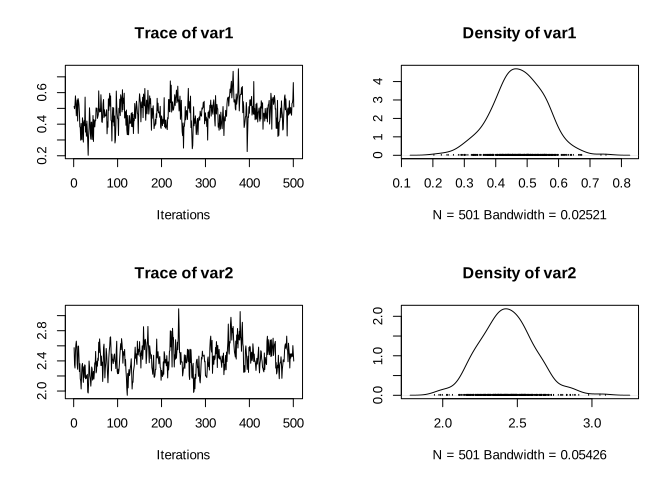
dfMU <- data.frame(mu1 = PostMu[keep,1], mu2 = PostMu[keep,2])
# Plot
require(latex2exp)
ggplot(dfMU) + geom_density(aes(x = mu1, color = "mu1"), linewidth = 1) + geom_density(aes(x = mu2, color = "mu2"), linewidth = 1) + labs(title = "Density Plot", x = TeX("$\\mu$"), y = "Density", color = "Variable") + theme_minimal() + scale_color_manual(values = c("mu1" = "blue", "mu2" = "red"))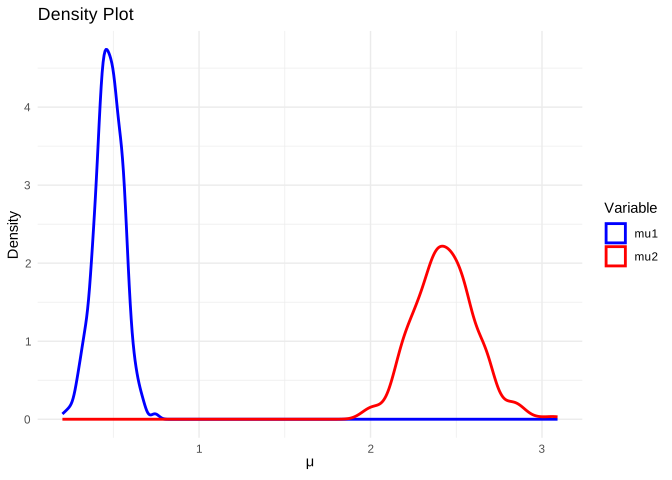
The figure shows the posterior densities of the location parameters. The posterior means are 0.42 and 2.50, with 95% credible intervals of (0.07, 0.71) and (2.34, 2.65), respectively. The posterior mean of the probability is 0.27, with a 95% credible interval of (0.19, 0.35). Note that in this simple simulation exercise, we did not observe unintended consequences from using non-informative priors and not standardizing the data. However, real-world applications should take these aspects into account.
We perform the same exercise assuming \(\beta_{01}=0.5\) and \(\beta_{02}=1\). The figure shows the posterior densities, where we observe significant overlap. The posterior means are 0.77 in both cases, with 95% credible intervals of (0.40, 1.05) and (-0.44, 1.71). The posterior mean of the probability is 0.84.
rm(list = ls()); set.seed(010101); library(ggplot2)
# Simulate data from a 2-component mixture model
n <- 500
z <- rbinom(n, 1, 0.75)  # Latent class indicator
y <- ifelse(z == 1, rnorm(n, 0.5, 1), rnorm(n, 1, 1))
data <- data.frame(y)
# Plot
ggplot(data, aes(x = y)) +
geom_density(fill = "blue", alpha = 0.3) + labs(title = "Density Plot", x = "y", y = "Density") + theme_minimal()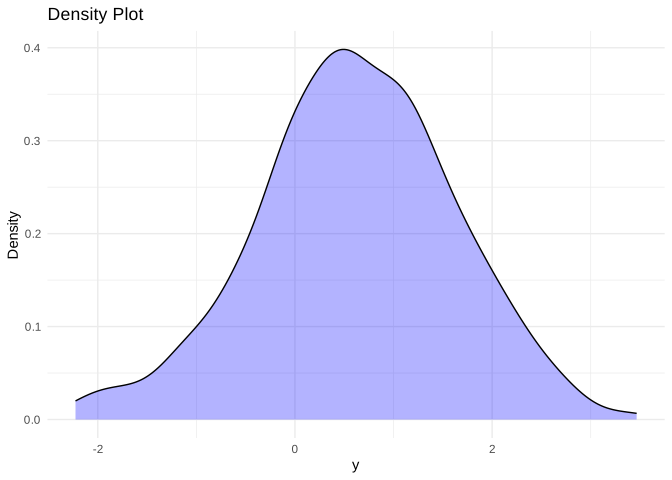
# Hyperparameters
mu0 <- 0; sig2mu0 <- 10; H <- 2; a0h <- rep(1/H, H)
# MCMC parameters
mcmc <- 1000; burnin <- 500; tot <- mcmc + burnin; thin <- 2
# Gibbs sampling functions
Postmu <- function(yh){
    Nh <- length(yh)
    sig2mu <- (1/sig2mu0 + Nh)^(-1)
    mun <- sig2mu*(mu0/sig2mu0 + sum(yh))
    mu <- rnorm(1, mun, sig2mu^0.5)
    return(mu)
}
PostPsi <- matrix(NA, tot, n); PostMu <- matrix(NA, tot, H)
PostLambda <- rep(NA, tot)
Id1 <- which(y <= 1) # 1 is from inspection of the density plot of y
Id2 <- which(y > 1)
N1 <- length(Id1); N2 <- length(Id2)
Lambda <- c(N1/n, N2/n)
MU <- c(mean(y[Id1]), mean(y[Id2])); Psi <- rep(NA, n)
pb <- txtProgressBar(min = 0, max = tot, style = 3)
## | | | 0%for(s in 1:tot){
for(i in 1:n){
lambdai <- NULL
for(h in 1:H){
lambdaih <- Lambda[h]*dnorm(y[i], MU[h], 1)
lambdai <- c(lambdai, lambdaih)
}
Psi[i] <- sample(1:H, 1, prob = lambdai)
}
PostPsi[s, ] <- Psi
for(h in 1:H){
idh <- which(Psi == h); MU[h] <- Postmu(yh = y[idh])
}
PostMu[s,] <- MU;
Lambda <- sort(MCMCpack::rdirichlet(1, a0h + table(Psi)), decreasing = TRUE)
PostLambda[s] <- Lambda[1]
setTxtProgressBar(pb, s)
}## | | | 1% | |= | 1% | |= | 2% | |== | 2% | |== | 3% | |== | 4% | |=== | 4% | |=== | 5% | |==== | 5% | |==== | 6% | |===== | 6% | |===== | 7% | |===== | 8% | |====== | 8% | |====== | 9% | |======= | 9% | |======= | 10% | |======= | 11% | |======== | 11% | |======== | 12% | |========= | 12% | |========= | 13% | |========= | 14% | |========== | 14% | |========== | 15% | |=========== | 15% | |=========== | 16% | |============ | 16% | |============ | 17% | |============ | 18% | |============= | 18% | |============= | 19% | |============== | 19% | |============== | 20% | |============== | 21% | |=============== | 21% | |=============== | 22% | |================ | 22% | |================ | 23% | |================ | 24% | |================= | 24% | |================= | 25% | |================== | 25%## Warning in a0h + table(Psi): Recycling array of length 1 in vector-array arithmetic is deprecated.
## Use c() or as.vector() instead.## | |================== | 26% | |=================== | 26% | |=================== | 27% | |=================== | 28% | |==================== | 28% | |==================== | 29% | |===================== | 29% | |===================== | 30% | |===================== | 31% | |====================== | 31% | |====================== | 32% | |======================= | 32% | |======================= | 33% | |======================= | 34% | |======================== | 34% | |======================== | 35% | |========================= | 35% | |========================= | 36% | |========================== | 36% | |========================== | 37% | |========================== | 38% | |=========================== | 38% | |=========================== | 39% | |============================ | 39% | |============================ | 40% | |============================ | 41% | |============================= | 41%## Warning in a0h + table(Psi): Recycling array of length 1 in vector-array arithmetic is deprecated.
## Use c() or as.vector() instead.## | |============================= | 42% | |============================== | 42% | |============================== | 43% | |============================== | 44% | |=============================== | 44% | |=============================== | 45% | |================================ | 45% | |================================ | 46% | |================================= | 46% | |================================= | 47% | |================================= | 48% | |================================== | 48% | |================================== | 49% | |=================================== | 49% | |=================================== | 50% | |=================================== | 51% | |==================================== | 51% | |==================================== | 52% | |===================================== | 52% | |===================================== | 53% | |===================================== | 54% | |====================================== | 54% | |====================================== | 55% | |======================================= | 55% | |======================================= | 56% | |======================================== | 56% | |======================================== | 57% | |======================================== | 58% | |========================================= | 58% | |========================================= | 59% | |========================================== | 59% | |========================================== | 60% | |========================================== | 61% | |=========================================== | 61% | |=========================================== | 62% | |============================================ | 62% | |============================================ | 63% | |============================================ | 64% | |============================================= | 64% | |============================================= | 65% | |============================================== | 65% | |============================================== | 66% | |=============================================== | 66% | |=============================================== | 67% | |=============================================== | 68% | |================================================ | 68% | |================================================ | 69% | |================================================= | 69% | |================================================= | 70% | |================================================= | 71% | |================================================== | 71% | |================================================== | 72% | |=================================================== | 72% | |=================================================== | 73% | |=================================================== | 74% | |==================================================== | 74% | |==================================================== | 75% | |===================================================== | 75% | |===================================================== | 76% | |====================================================== | 76% | |====================================================== | 77% | |====================================================== | 78% | |======================================================= | 78% | |======================================================= | 79% | |======================================================== | 79% | |======================================================== | 80% | |======================================================== | 81% | |========================================================= | 81% | |========================================================= | 82% | |========================================================== | 82% | |========================================================== | 83% | |========================================================== | 84% | |=========================================================== | 84% | |=========================================================== | 85% | |============================================================ | 85% | |============================================================ | 86% | |============================================================= | 86% | |============================================================= | 87% | |============================================================= | 88% | |============================================================== | 88%## Warning in a0h + table(Psi): Recycling array of length 1 in vector-array arithmetic is deprecated.
## Use c() or as.vector() instead.## | |============================================================== | 89% | |=============================================================== | 89% | |=============================================================== | 90% | |=============================================================== | 91% | |================================================================ | 91% | |================================================================ | 92% | |================================================================= | 92% | |================================================================= | 93% | |================================================================= | 94% | |================================================================== | 94% | |================================================================== | 95% | |=================================================================== | 95% | |=================================================================== | 96% | |==================================================================== | 96% | |==================================================================== | 97% | |==================================================================== | 98% | |===================================================================== | 98% | |===================================================================== | 99% | |======================================================================| 99% | |======================================================================| 100%keep <- seq(burnin, tot, thin)
PosteriorMUs <- coda::mcmc(PostMu[keep,])
summary(PosteriorMUs); plot(PosteriorMUs)##
## Iterations = 1:501
## Thinning interval = 1
## Number of chains = 1
## Sample size per chain = 501
##
## 1. Empirical mean and standard deviation for each variable,
## plus standard error of the mean:
##
## Mean SD Naive SE Time-series SE
## [1,] 0.6343 0.1288 0.005755 0.02345
## [2,] 0.4272 0.5252 0.023462 0.10092
##
## 2. Quantiles for each variable:
##
## 2.5% 25% 50% 75% 97.5%
## var1 0.3401 0.5569 0.6378 0.7314 0.8522
## var2 -0.5139 0.1637 0.4479 0.7496 1.2623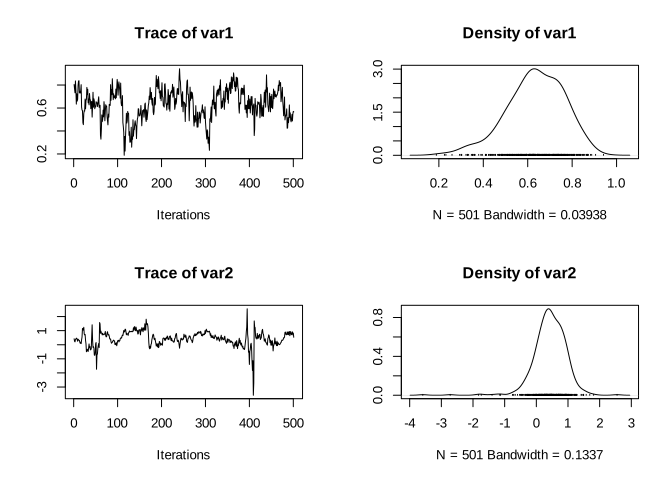
dfMU <- data.frame(mu1 = PostMu[keep,1], mu2 = PostMu[keep,2])
# Plot
require(latex2exp)
ggplot(dfMU) + geom_density(aes(x = mu1, color = "mu1"), linewidth = 1) + geom_density(aes(x = mu2, color = "mu2"), linewidth = 1) + labs(title = "Density Plot", x = TeX("$\\mu$"), y = "Density", color = "Variable") + theme_minimal() + scale_color_manual(values = c("mu1" = "blue", "mu2" = "red"))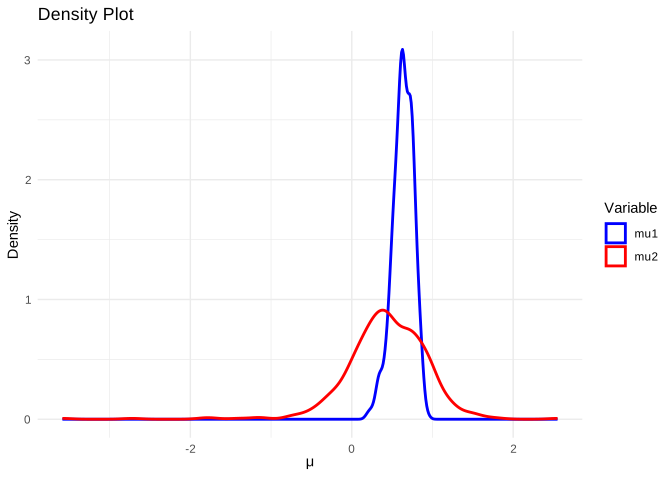
In the second setting, the posterior draws of the Gibbs sampler can switch between the two means because they are relatively close. This situation contrasts with the first example, where there is a relatively large separation between the means, resulting in a region of the parameter space with zero probability (see the flat region between the two posterior distributions in that example). The key point is that, given a sufficiently large number of Gibbs sampler iterations, the algorithm should eventually explore the entire parameter space and encounter the label-switching issue. This occurs because both posterior chains should exhibit similar behavior, as they are targeting the same distribution.
We can implement random permutation of latent classes to address this issue. This involves sampling a random permutation of the labels at each iteration of the MCMC algorithm. For example, with three clusters, there are \(3! = 6\) possible label permutations. Let the permutations be labeled as \(\boldsymbol{p}_k=\left\{p_k(1),p_k(2),\dots,p_k(H)\right\}, k=1,2,\dots,H!\). At the end of each iteration in the MCMC algorithm, we randomly select one of the permutations \(\boldsymbol{p}_k\) and replace the cluster probabilities \(\lambda_1^{(s)},\dots,\lambda_H^{(s)}\) with \(\lambda_{p_k(1)}^{(s)},\dots,\lambda_{p_k(H)}^{(s)}\). We apply the same permutation to \(\boldsymbol{\beta}^{(s)}\), \(\sigma^{2(s)}\), and \(\boldsymbol{\psi}_{i}^{(s)}\), for \(i=1,2,\dots,n\). The following algorithm illustrates how to implement this in our simple example.
###### Permutations ######
rm(list = ls()); set.seed(010101); library(ggplot2)
# Simulate data from a 2-component mixture model
n <- 500
z <- rbinom(n, 1, 0.75)  # Latent class indicator
y <- ifelse(z == 1, rnorm(n, 0.5, 1), rnorm(n, 2.5, 1))
# Hyperparameters
mu0 <- 0; sig2mu0 <- 10; H <- 2; a0h <- rep(1/H, H)
# MCMC parameters
mcmc <- 2000; burnin <- 500
tot <- mcmc + burnin; thin <- 2
# Gibbs sampling functions
Postmu <- function(yh){
    Nh <- length(yh)
    sig2mu <- (1/sig2mu0 + Nh)^(-1)
    mun <- sig2mu*(mu0/sig2mu0 + sum(yh))
    mu <- rnorm(1, mun, sig2mu^0.5)
    return(mu)
}
PostPsi <- matrix(NA, tot, n); PostMu <- matrix(NA, tot, H)
PostLambda <- rep(NA, tot)
Id1 <- which(y <= 1); Id2 <- which(y > 1)
N1 <- length(Id1); N2 <- length(Id2)
Lambda <- c(N1/n, N2/n); MU <- c(mean(y[Id1]), mean(y[Id2]))
Psi <- rep(NA, n); per1 <- c(1,2); per2 <- c(2,1)
pb <- txtProgressBar(min = 0, max = tot, style = 3)
## | | | 0%for(s in 1:tot){
for(i in 1:n){
lambdai <- NULL
for(h in 1:H){
lambdaih <- Lambda[h]*dnorm(y[i], MU[h], 1)
lambdai <- c(lambdai, lambdaih)
}
Psi[i] <- sample(1:H, 1, prob = lambdai)
}
for(h in 1:H){
idh <- which(Psi == h)
MU[h] <- Postmu(yh = y[idh])
}
Lambda <- MCMCpack::rdirichlet(1, a0h + table(Psi))
# Permutations
labels <- sample(1:2, 1, prob = c(0.5, 0.5))
if(labels == 2){
Lambda <- Lambda[per2]
MU <- MU[per2]
for(i in 1:n){
if(Psi[i] == 1){Psi[i] <- 2
}else{Psi[i] <- 1}
}
}
PostPsi[s, ] <- Psi; PostMu[s,] <- MU
PostLambda[s] <- Lambda[1]
setTxtProgressBar(pb, s)
}## | | | 1% | |= | 1% | |= | 2% | |== | 2% | |== | 3% | |== | 4% | |=== | 4% | |=== | 5% | |==== | 5% | |==== | 6% | |===== | 6% | |===== | 7% | |===== | 8% | |====== | 8% | |====== | 9% | |======= | 9% | |======= | 10% | |======= | 11% | |======== | 11% | |======== | 12% | |========= | 12% | |========= | 13% | |========= | 14% | |========== | 14% | |========== | 15% | |=========== | 15% | |=========== | 16% | |============ | 16% | |============ | 17% | |============ | 18% | |============= | 18% | |============= | 19% | |============== | 19% | |============== | 20% | |============== | 21% | |=============== | 21% | |=============== | 22% | |================ | 22% | |================ | 23% | |================ | 24% | |================= | 24% | |================= | 25% | |================== | 25% | |================== | 26% | |=================== | 26% | |=================== | 27% | |=================== | 28% | |==================== | 28% | |==================== | 29% | |===================== | 29% | |===================== | 30% | |===================== | 31% | |====================== | 31% | |====================== | 32% | |======================= | 32% | |======================= | 33% | |======================= | 34% | |======================== | 34% | |======================== | 35% | |========================= | 35% | |========================= | 36% | |========================== | 36% | |========================== | 37% | |========================== | 38% | |=========================== | 38% | |=========================== | 39% | |============================ | 39% | |============================ | 40% | |============================ | 41% | |============================= | 41% | |============================= | 42% | |============================== | 42% | |============================== | 43% | |============================== | 44% | |=============================== | 44% | |=============================== | 45% | |================================ | 45% | |================================ | 46% | |================================= | 46% | |================================= | 47% | |================================= | 48% | |================================== | 48% | |================================== | 49% | |=================================== | 49% | |=================================== | 50% | |=================================== | 51% | |==================================== | 51% | |==================================== | 52% | |===================================== | 52% | |===================================== | 53% | |===================================== | 54% | |====================================== | 54% | |====================================== | 55% | |======================================= | 55% | |======================================= | 56% | |======================================== | 56% | |======================================== | 57% | |======================================== | 58% | |========================================= | 58% | |========================================= | 59% | |========================================== | 59% | |========================================== | 60% | |========================================== | 61% | |=========================================== | 61% | |=========================================== | 62% | |============================================ | 62% | |============================================ | 63% | |============================================ | 64% | |============================================= | 64% | |============================================= | 65% | |============================================== | 65% | |============================================== | 66% | |=============================================== | 66% | |=============================================== | 67% | |=============================================== | 68% | |================================================ | 68% | |================================================ | 69% | |================================================= | 69% | |================================================= | 70% | |================================================= | 71% | |================================================== | 71% | |================================================== | 72% | |=================================================== | 72% | |=================================================== | 73% | |=================================================== | 74% | |==================================================== | 74% | |==================================================== | 75% | |===================================================== | 75% | |===================================================== | 76% | |====================================================== | 76% | |====================================================== | 77% | |====================================================== | 78% | |======================================================= | 78% | |======================================================= | 79% | |======================================================== | 79% | |======================================================== | 80% | |======================================================== | 81% | |========================================================= | 81% | |========================================================= | 82% | |========================================================== | 82% | |========================================================== | 83% | |========================================================== | 84% | |=========================================================== | 84% | |=========================================================== | 85% | |============================================================ | 85% | |============================================================ | 86% | |============================================================= | 86% | |============================================================= | 87% | |============================================================= | 88% | |============================================================== | 88% | |============================================================== | 89% | |=============================================================== | 89% | |=============================================================== | 90% | |=============================================================== | 91% | |================================================================ | 91% | |================================================================ | 92% | |================================================================= | 92% | |================================================================= | 93% | |================================================================= | 94% | |================================================================== | 94% | |================================================================== | 95% | |=================================================================== | 95% | |=================================================================== | 96% | |==================================================================== | 96% | |==================================================================== | 97% | |==================================================================== | 98% | |===================================================================== | 98% | |===================================================================== | 99% | |======================================================================| 99% | |======================================================================| 100%##
## Iterations = 1:1001
## Thinning interval = 1
## Number of chains = 1
## Sample size per chain = 1001
##
## 1. Empirical mean and standard deviation for each variable,
## plus standard error of the mean:
##
## Mean SD Naive SE Time-series SE
## [1,] 1.434 0.9904 0.03130 0.03130
## [2,] 1.482 0.9929 0.03138 0.03138
##
## 2. Quantiles for each variable:
##
## 2.5% 25% 50% 75% 97.5%
## var1 0.3283 0.4773 0.647 2.421 2.772
## var2 0.3317 0.4830 2.072 2.443 2.750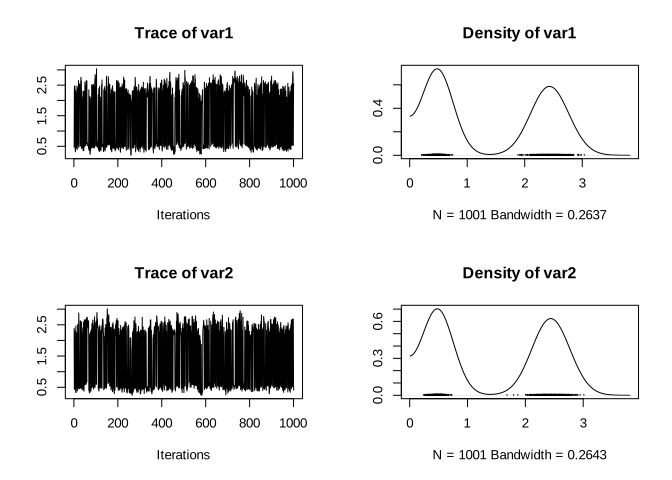
dfMU <- data.frame(mu1 = PostMu[keep,1], mu2 = PostMu[keep,2])
# Plot
require(latex2exp)
ggplot(dfMU) +
geom_density(aes(x = mu1, color = "mu1"), linewidth = 1) +  # First density plot
geom_density(aes(x = mu2, color = "mu2"), linewidth = 1) +  # Second density plot
labs(title = "Density Plot", x = TeX("$\\mu$"), y = "Density", color = "Variable") + theme_minimal() + scale_color_manual(values = c("mu1" = "blue", "mu2" = "red"))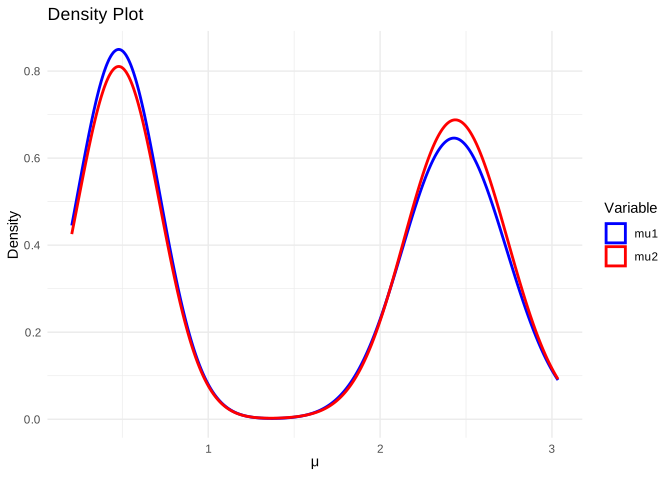
##
## Iterations = 1:1001
## Thinning interval = 1
## Number of chains = 1
## Sample size per chain = 1001
##
## 1. Empirical mean and standard deviation for each variable,
##    plus standard error of the mean:
##
##           Mean             SD       Naive SE Time-series SE
##       0.505792       0.248938       0.007868       0.007868
##
## 2. Quantiles for each variable:
##
##   2.5%    25%    50%    75%  97.5%
## 0.1833 0.2524 0.6232 0.7471 0.8263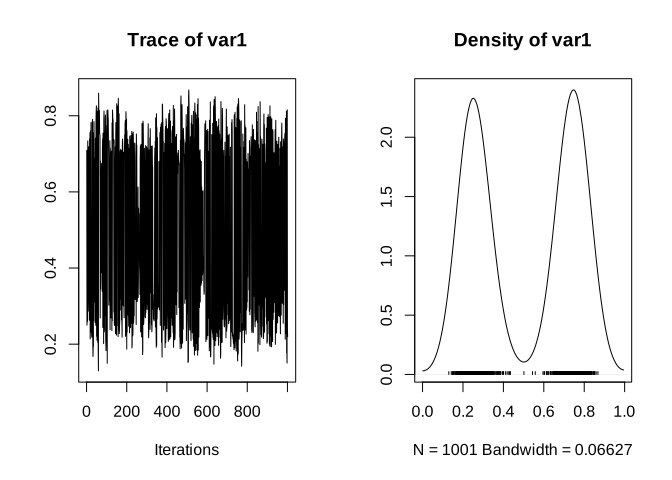
The figure shows the posterior distributions from the random permutation of latent classes in the first simulation setting. We observe that both posterior distributions look similar, as both are targeting a bimodal distribution given by two clusters.
In the following setting we simulate a simple regression mixture with two components such that \(\psi_{i1}\sim \text{Ber}(0.5)\), consequently, \(\psi_{i2}=1-\psi_{i1}\), and assume one regressor, \(x_i\sim N(0,1)\), \(i=1,2,\dots,1,000\). Then, \[p(y_i \mid \boldsymbol{x}_i) = 0.5 \phi(y_i \mid 2+1.5x_i,1^2)+0.5 \phi(y_i \mid -1+0.5x_i,0.8^2).\]
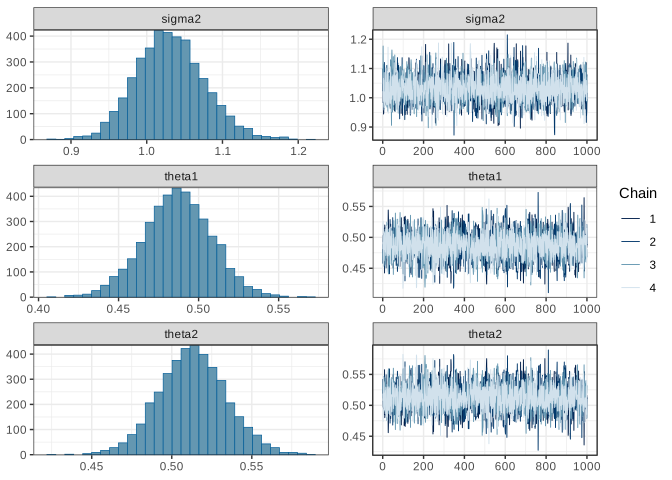
The following code shows how to perform inference in this model, assuming \(N(0,5)\) and \(N(0,2)\) priors for the intercepts and slopes, respectively. Additionally, we use a \(Cauchy(0,2)\) prior truncated at 0 for the standard deviations, and a \(Dirichlet(1,1)\) prior for the probabilities. We use the brms package in R, which in turn uses Stan, setting number of MCMC iterations 2,000, a burn-in (warm-up) equal to 1,000, and 4 chains. Remember that Stan software uses Hamiltonian Monte Carlo.
####### Simulation exercise: Gaussian mixture: 2 components #############
rm(list = ls())
set.seed(010101)
library(brms)
## Loading required package: Rcpp## Loading 'brms' package (version 2.22.0). Useful instructions
## can be found by typing help('brms'). A more detailed introduction
## to the package is available through vignette('brms_overview').##
## Attaching package: 'brms'## The following objects are masked from 'package:bayesforecast':
##
## exponential, get_prior, loo, mcmc_plot, posterior_interval,
## set_prior, student## The following objects are masked from 'package:LaplacesDemon':
##
## ddirichlet, rdirichlet, WAIC## The following object is masked from 'package:Compositional':
##
## frechet## The following objects are masked from 'package:MCMCpack':
##
## ddirichlet, rdirichlet## The following object is masked from 'package:sirt':
##
## mcmc_plot## The following object is masked from 'package:stats':
##
## arlibrary(ggplot2)
# Simulate data from a 2-component mixture model
n <- 1000
x <- rnorm(n)
z <- rbinom(n, 1, 0.5) # Latent class indicator
y <- ifelse(z == 1, rnorm(n, 2 + 1.5*x, 1), rnorm(n, -1 + 0.5*x, 0.8))
data <- data.frame(y, x)
# Plot
ggplot(data, aes(x = y)) +
geom_density(fill = "blue", alpha = 0.3) + # Density plot with fill color
labs(title = "Density Plot", x = "y", y = "Density") +
theme_minimal()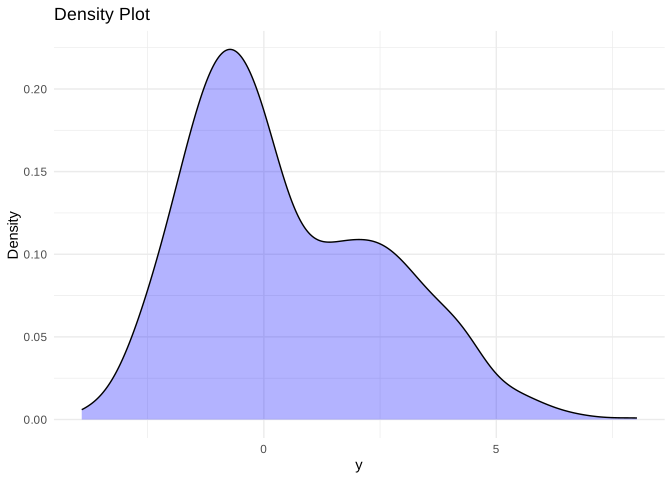
# Define priors
priors <- c(
set_prior("normal(0, 5)", class = "Intercept", dpar = "mu1"),  # First component intercept
set_prior("normal(0, 5)", class = "Intercept", dpar = "mu2"),  # Second component intercept
set_prior("normal(0, 2)", class = "b", dpar = "mu1"),  # First component slope
set_prior("normal(0, 2)", class = "b", dpar = "mu2"),  # Second component slope
set_prior("cauchy(0, 2)", class = "sigma1", lb = 0),  # First component sigma
set_prior("cauchy(0, 2)", class = "sigma2", lb = 0),  # Second component sigma
set_prior("dirichlet(1, 1)", class = "theta")  # Mixing proportions
)

# Fit a 2-component Gaussian mixture regression model
fit <- brm(
bf(y ~ 1 + x, family = mixture(gaussian, gaussian)),  # Two normal distributions
data = data,
prior = priors,
chains = 4, iter = 2000, warmup = 1000, cores = 4
)
## Setting order = 'mu' for mixtures of the same family.## Compiling Stan program...## Start sampling## prior class coef group resp dpar nlpar lb ub source
## normal(0, 2) b mu1 user
## normal(0, 2) b x mu1 (vectorized)
## normal(0, 2) b mu2 user
## normal(0, 2) b x mu2 (vectorized)
## normal(0, 5) Intercept mu1 user
## normal(0, 5) Intercept mu2 user
## cauchy(0, 2) sigma1 0 user
## cauchy(0, 2) sigma2 0 user
## dirichlet(1, 1) theta user## Family: mixture(gaussian, gaussian)
## Links: mu1 = identity; sigma1 = identity; mu2 = identity; sigma2 = identity; theta1 = identity; theta2 = identity
## Formula: y ~ 1 + x
## Data: data (Number of observations: 1000)
## Draws: 4 chains, each with iter = 2000; warmup = 1000; thin = 1;
## total post-warmup draws = 4000
##
## Regression Coefficients:
## Estimate Est.Error l-95% CI u-95% CI Rhat Bulk_ESS Tail_ESS
## mu1_Intercept -1.03 0.05 -1.12 -0.94 1.00 3774 3227
## mu2_Intercept 1.99 0.06 1.86 2.10 1.00 3920 3341
## mu1_x 0.45 0.05 0.36 0.54 1.00 4855 2753
## mu2_x 1.46 0.05 1.36 1.56 1.00 4901 2880
##
## Further Distributional Parameters:
## Estimate Est.Error l-95% CI u-95% CI Rhat Bulk_ESS Tail_ESS
## sigma1 0.80 0.03 0.73 0.86 1.00 4770 2923
## sigma2 1.03 0.05 0.95 1.13 1.00 4126 3116
## theta1 0.49 0.02 0.44 0.53 1.00 4018 2718
## theta2 0.51 0.02 0.47 0.56 1.00 4018 2718
##
## Draws were sampled using sampling(NUTS). For each parameter, Bulk_ESS
## and Tail_ESS are effective sample size measures, and Rhat is the potential
## scale reduction factor on split chains (at convergence, Rhat = 1).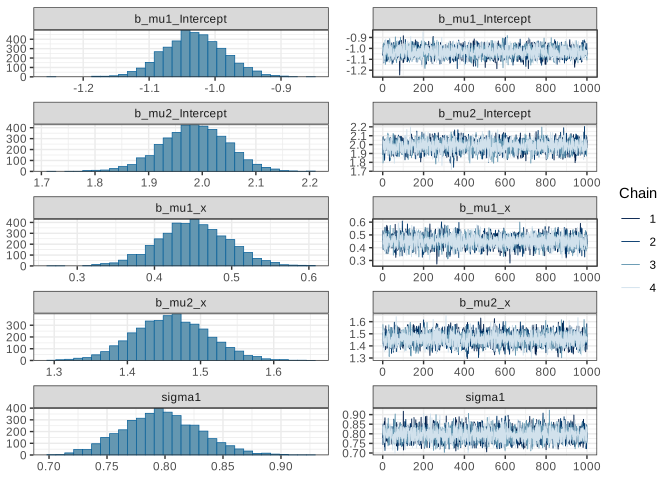
 The following code performs inference in this simulation from scratch using Gibbs sampling. We do not implement the random permutation of latent classes algorithm for facilitating exposition and comparability with the results from the package brms. We use non-informative priors, setting \(\alpha_{h0}=\delta_{h0}=0.01\), \(\boldsymbol{\beta}_{h0}=\boldsymbol{0}_2\), \(\boldsymbol{B}_{h0}=\boldsymbol{I}_2\), and \(\boldsymbol{\alpha}_0=[1/2 \ 1/2]^{\top}\). The number of MCMC iterations is 5,000, the burn-in is 1,000, and the thinning parameter is 2. In general, the Gibbs sampler appears to yield good posterior results as all 95% intervals encompass the population parameters.
########### Perform inference from scratch ###############
rm(list = ls()); set.seed(010101)
library(brms); library(ggplot2)
# Simulate data from a 2-component mixture model
n <- 1000
x <- rnorm(n)
z <- rbinom(n, 1, 0.5)  # Latent class indicator
y <- ifelse(z == 1, rnorm(n, 2 + 1.5*x, 1), rnorm(n, -1 + 0.5*x, 0.8))
# Hyperparameters
d0 <- 0.001; a0 <- 0.001
b0 <- rep(0, 2); B0 <- diag(2); B0i <- solve(B0)
a01 <- 1/2; a02 <- 1/2
# MCMC parameters
mcmc <- 5000; burnin <- 1000
tot <- mcmc + burnin; thin <- 2
# Gibbs sampling functions
PostSig2 <- function(Betah, Xh, yh){
    Nh <- length(yh); an <- a0 + Nh
    dn <- d0 + t(yh - Xh%*%Betah)%*%(yh - Xh%*%Betah)
    sig2 <- invgamma::rinvgamma(1, shape = an/2, rate = dn/2)
    return(sig2)
}
PostBeta <- function(sig2h, Xh, yh){
    Bn <- solve(B0i + sig2h^(-1)*t(Xh)%*%Xh)
    bn <- Bn%*%(B0i%*%b0 + sig2h^(-1)*t(Xh)%*%yh)
    Beta <- MASS::mvrnorm(1, bn, Bn)
    return(Beta)
}
PostBetas1 <- matrix(0, mcmc+burnin, 2)
PostBetas2 <- matrix(0, mcmc+burnin, 2)
PostSigma21 <- rep(0, mcmc+burnin)
PostSigma22 <- rep(0, mcmc+burnin)
PostPsi <- matrix(0, mcmc+burnin, n)
PostLambda <- rep(0, mcmc+burnin)
Id1 <- which(y<1) # 1 is from inspection of the density plot of y
N1 <- length(Id1); Lambda1 <- N1/n
Id2 <- which(y>=1)
N2 <- length(Id2); Lambda2 <- N2/n
Reg1 <- lm(y ~ x, subset = Id1)
SumReg1 <- summary(Reg1); Beta1 <- Reg1$coefficients
sig21 <- SumReg1$sigma^2
Reg2 <- lm(y ~ x, subset = Id2); SumReg2 <- summary(Reg2)
Beta2 <- Reg2$coefficients
sig22 <- SumReg2$sigma^2
X <- cbind(1, x); Psi <- rep(NA, n)
pb <- txtProgressBar(min = 0, max = tot, style = 3)
## | | | 0%for(s in 1:tot){
for(i in 1:n){
lambdai1 <- Lambda1*dnorm(y[i], X[i,]%*%Beta1, sig21^0.5)
lambdai2 <- Lambda2*dnorm(y[i], X[i,]%*%Beta2, sig22^0.5)
Psi[i] <- sample(c(1,2), 1, prob = c(lambdai1, lambdai2))
}
PostPsi[s, ] <- Psi
Id1 <- which(Psi == 1); Id2 <- which(Psi == 2)
N1 <- length(Id1); N2 <- length(Id2)
sig21 <- PostSig2(Betah = Beta1, Xh = X[Id1, ], yh = y[Id1])
sig22 <- PostSig2(Betah = Beta2, Xh = X[Id2, ], yh = y[Id2])
PostSigma21[s] <- sig21; PostSigma22[s] <- sig22
Beta1 <- PostBeta(sig2h = sig21, Xh = X[Id1, ], yh = y[Id1])
Beta2 <- PostBeta(sig2h = sig22, Xh = X[Id2, ], yh = y[Id2])
PostBetas1[s,] <- Beta1; PostBetas2[s,] <- Beta2
Lambda <- sort(MCMCpack::rdirichlet(1, c(a01 + N1, a02 + N2)), decreasing = TRUE)
Lambda1 <- Lambda[1]; Lambda2 <- Lambda[2]
PostLambda[s] <- Lambda1
setTxtProgressBar(pb, s)
}## | | | 1% | |= | 1% | |= | 2% | |== | 2% | |== | 3% | |== | 4% | |=== | 4% | |=== | 5% | |==== | 5% | |==== | 6% | |===== | 6% | |===== | 7% | |===== | 8% | |====== | 8% | |====== | 9% | |======= | 9% | |======= | 10% | |======= | 11% | |======== | 11% | |======== | 12% | |========= | 12% | |========= | 13% | |========= | 14% | |========== | 14% | |========== | 15% | |=========== | 15% | |=========== | 16% | |============ | 16% | |============ | 17% | |============ | 18% | |============= | 18% | |============= | 19% | |============== | 19% | |============== | 20% | |============== | 21% | |=============== | 21% | |=============== | 22% | |================ | 22% | |================ | 23% | |================ | 24% | |================= | 24% | |================= | 25% | |================== | 25% | |================== | 26% | |=================== | 26% | |=================== | 27% | |=================== | 28% | |==================== | 28% | |==================== | 29% | |===================== | 29% | |===================== | 30% | |===================== | 31% | |====================== | 31% | |====================== | 32% | |======================= | 32% | |======================= | 33% | |======================= | 34% | |======================== | 34% | |======================== | 35% | |========================= | 35% | |========================= | 36% | |========================== | 36% | |========================== | 37% | |========================== | 38% | |=========================== | 38% | |=========================== | 39% | |============================ | 39% | |============================ | 40% | |============================ | 41% | |============================= | 41% | |============================= | 42% | |============================== | 42% | |============================== | 43% | |============================== | 44% | |=============================== | 44% | |=============================== | 45% | |================================ | 45% | |================================ | 46% | |================================= | 46% | |================================= | 47% | |================================= | 48% | |================================== | 48% | |================================== | 49% | |=================================== | 49% | |=================================== | 50% | |=================================== | 51% | |==================================== | 51% | |==================================== | 52% | |===================================== | 52% | |===================================== | 53% | |===================================== | 54% | |====================================== | 54% | |====================================== | 55% | |======================================= | 55% | |======================================= | 56% | |======================================== | 56% | |======================================== | 57% | |======================================== | 58% | |========================================= | 58% | |========================================= | 59% | |========================================== | 59% | |========================================== | 60% | |========================================== | 61% | |=========================================== | 61% | |=========================================== | 62% | |============================================ | 62% | |============================================ | 63% | |============================================ | 64% | |============================================= | 64% | |============================================= | 65% | |============================================== | 65% | |============================================== | 66% | |=============================================== | 66% | |=============================================== | 67% | |=============================================== | 68% | |================================================ | 68% | |================================================ | 69% | |================================================= | 69% | |================================================= | 70% | |================================================= | 71% | |================================================== | 71% | |================================================== | 72% | |=================================================== | 72% | |=================================================== | 73% | |=================================================== | 74% | |==================================================== | 74% | |==================================================== | 75% | |===================================================== | 75% | |===================================================== | 76% | |====================================================== | 76% | |====================================================== | 77% | |====================================================== | 78% | |======================================================= | 78% | |======================================================= | 79% | |======================================================== | 79% | |======================================================== | 80% | |======================================================== | 81% | |========================================================= | 81% | |========================================================= | 82% | |========================================================== | 82% | |========================================================== | 83% | |========================================================== | 84% | |=========================================================== | 84% | |=========================================================== | 85% | |============================================================ | 85% | |============================================================ | 86% | |============================================================= | 86% | |============================================================= | 87% | |============================================================= | 88% | |============================================================== | 88% | |============================================================== | 89% | |=============================================================== | 89% | |=============================================================== | 90% | |=============================================================== | 91% | |================================================================ | 91% | |================================================================ | 92% | |================================================================= | 92% | |================================================================= | 93% | |================================================================= | 94% | |================================================================== | 94% | |================================================================== | 95% | |=================================================================== | 95% | |=================================================================== | 96% | |==================================================================== | 96% | |==================================================================== | 97% | |==================================================================== | 98% | |===================================================================== | 98% | |===================================================================== | 99% | |======================================================================| 99% | |======================================================================| 100%keep <- seq((burnin+1), tot, thin)
PosteriorBetas1 <- coda::mcmc(PostBetas1[keep,])
summary(PosteriorBetas1)##
## Iterations = 1:2500
## Thinning interval = 1
## Number of chains = 1
## Sample size per chain = 2500
##
## 1. Empirical mean and standard deviation for each variable,
## plus standard error of the mean:
##
## Mean SD Naive SE Time-series SE
## [1,] -1.0106 0.04347 0.0008693 0.0010055
## [2,] 0.4441 0.04310 0.0008620 0.0009545
##
## 2. Quantiles for each variable:
##
## 2.5% 25% 50% 75% 97.5%
## var1 -1.0937 -1.0404 -1.0116 -0.9802 -0.9251
## var2 0.3591 0.4158 0.4433 0.4728 0.5291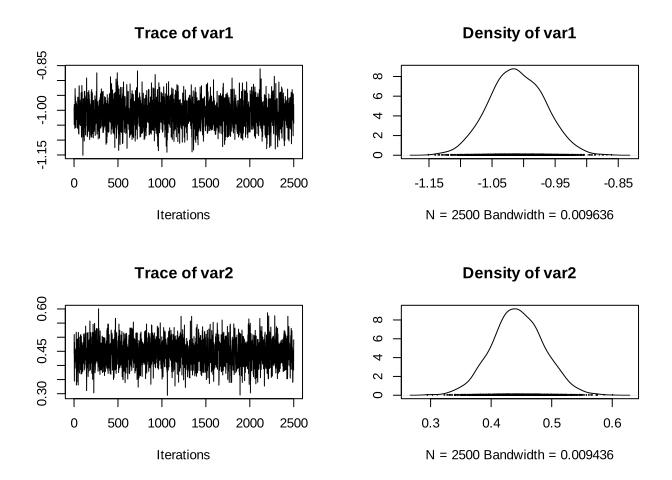
##
## Iterations = 1:2500
## Thinning interval = 1
## Number of chains = 1
## Sample size per chain = 2500
##
## 1. Empirical mean and standard deviation for each variable,
##    plus standard error of the mean:
##
##       Mean      SD Naive SE Time-series SE
## [1,] 2.012 0.05708 0.001142       0.001554
## [2,] 1.443 0.05043 0.001009       0.001175
##
## 2. Quantiles for each variable:
##
##       2.5%   25%   50%   75% 97.5%
## var1 1.896 1.976 2.011 2.050 2.126
## var2 1.346 1.409 1.442 1.476 1.540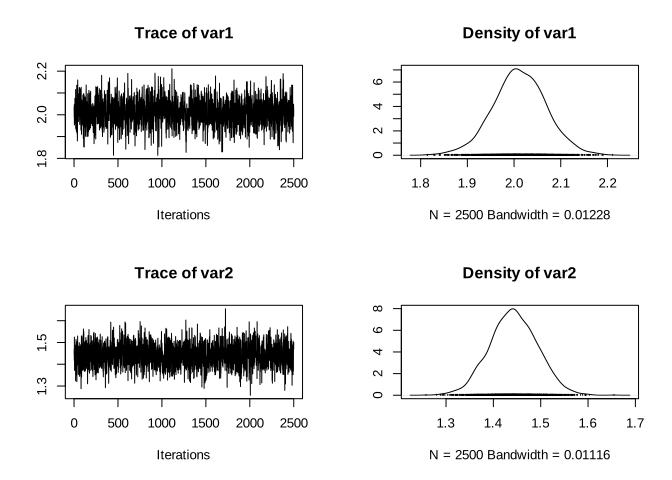
##
## Iterations = 1:2500
## Thinning interval = 1
## Number of chains = 1
## Sample size per chain = 2500
##
## 1. Empirical mean and standard deviation for each variable,
##    plus standard error of the mean:
##
##           Mean             SD       Naive SE Time-series SE
##       0.655851       0.052563       0.001051       0.001252
##
## 2. Quantiles for each variable:
##
##   2.5%    25%    50%    75%  97.5%
## 0.5598 0.6190 0.6530 0.6887 0.7646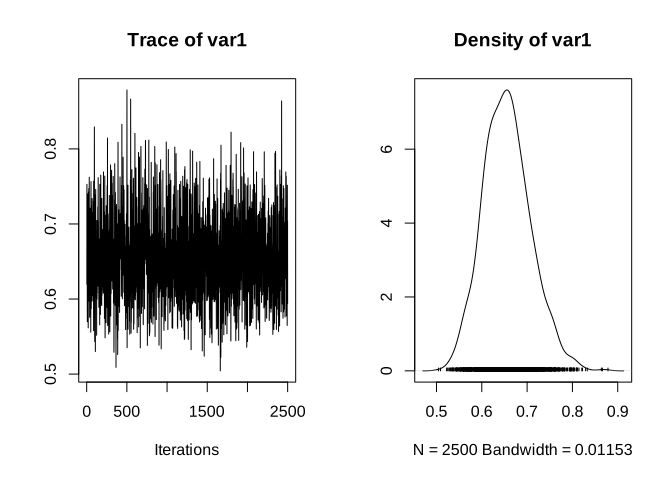
##
## Iterations = 1:2500
## Thinning interval = 1
## Number of chains = 1
## Sample size per chain = 2500
##
## 1. Empirical mean and standard deviation for each variable,
##    plus standard error of the mean:
##
##           Mean             SD       Naive SE Time-series SE
##       1.026974       0.084897       0.001698       0.002122
##
## 2. Quantiles for each variable:
##
##   2.5%    25%    50%    75%  97.5%
## 0.8749 0.9682 1.0203 1.0812 1.2122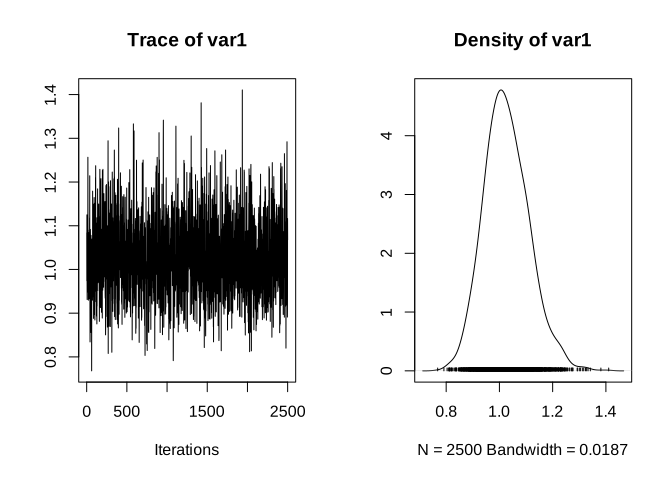
Let’s perform another simulation exercise in which we conduct a semi-parametric analysis where the stochastic error follows a Student’s t-distribution with 3 degrees of freedom. Specifically,
\[\begin{align*}
y_i &= 1 - 0.5x_{i1} + 1.5x_{i2} + \mu_i, \ i=1,2,\dots,500.
\end{align*}\]
The variables \(x_{i1}\) and \(x_{i2}\) are standard normally distributed. Let’s set \(H=5\), and use non-informative priors setting \(\alpha_{h0}=\delta_{h0}=0.01\), \(\boldsymbol{\beta}_0=\boldsymbol{0}_2\), \(\boldsymbol{B}_0=\boldsymbol{I}_2\), \(\mu_{h0}=0\), \(\sigma^2_{h0}=10\) and \(\boldsymbol{\alpha}_0=[1/H \ \dots \ 1/H]^{\top}\). Use 6,000 MCMC iterations, burn-in equal to 4,000, and thinning parameter equal to 2. In this exercise, there is no need to address the label-switching issue, as we are not specifically interested in the individual components of the posterior distributions of the clusters. Exercise 1 asks how to get the posterior density of the stochastic errors in semi-parametric specifications.
We can see from the posterior estimates that three components disappear after the burn-in iterations. The 95% credible intervals encompass the population values of the slope parameters. The 95% credible intervals for the probabilities are (0.70, 0.89) and (0.11, 0.30), and the 95% credible interval for the weighted average of the intercepts encompasses the population parameter.
rm(list = ls()); set.seed(010101)
library(ggplot2)
n <- 500
x1 <- rnorm(n); x2 <- rnorm(n)
X <- cbind(x1,x2); B <- c(-0.5, 1.5)
u <- rt(n, 3); y <- 1 + X%*%B + u
Reg <- lm(y ~ X)
Res <- Reg$residuals
data <- data.frame(Res)
# Plot
ggplot(data, aes(x = Res)) +
geom_density(fill = "blue", alpha = 0.3) +  # Density plot with fill color
labs(title = "Density Plot", x = "Residuals", y = "Density") +
theme_minimal()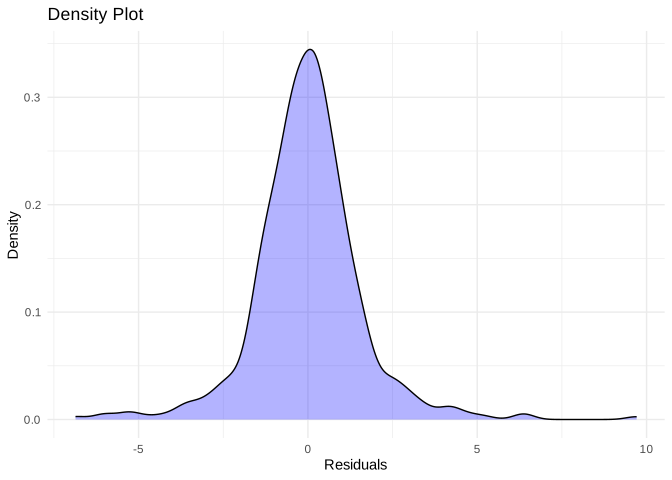
# Hyperparameters
d0 <- 0.001; a0 <- 0.001; b0 <- rep(0, 2)
B0 <- diag(2); B0i <- solve(B0)
mu0 <- 0; sig2mu0 <- 10; H <- 5; a0h <- rep(1/H, H)
# MCMC parameters
mcmc <- 2000; burnin <- 4000
tot <- mcmc + burnin; thin <- 2
# Gibbs sampling functions
PostSig2 <- function(Beta, muh, Xh, yh){
    Nh <- length(yh); an <- a0 + Nh
    dn <- d0 + t(yh - muh - Xh%*%Beta)%*%(yh - muh - Xh%*%Beta)
    sig2 <- invgamma::rinvgamma(1, shape = an/2, rate = dn/2)
    return(sig2)
}
PostBeta <- function(sig2, mu, X, y, Psi){
    XtX <- matrix(0, 2, 2); Xty <- matrix(0, 2, 1)
    Hs <- length(mu)
    for(h in 1:Hs){
        idh <- which(Psi == h)
        if(length(idh) == 1){
            Xh <- matrix(X[idh,], 1, 2)
            XtXh <- sig2[h]^(-1)*t(Xh)%*%Xh
            yh <- y[idh]
            Xtyh <- sig2[h]^(-1)*t(Xh)%*%(yh - mu[h])
        }else{
            Xh <- X[idh,]
            XtXh <- sig2[h]^(-1)*t(Xh)%*%Xh
            yh <- y[idh]
            Xtyh <- sig2[h]^(-1)*t(Xh)%*%(yh - mu[h])
        }
        XtX <- XtX + XtXh; Xty <- Xty + Xtyh
    }
    Bn <- solve(B0i + XtX); bn <- Bn%*%(B0i%*%b0 + Xty)
    Beta <- MASS::mvrnorm(1, bn, Bn)
    return(Beta)
}
Postmu <- function(sig2h, Beta, Xh, yh){
    Nh <- length(yh)
    sig2mu <- (1/sig2mu0 + Nh/sig2h)^(-1)
    mun <- sig2mu*(mu0/sig2mu0 + sum((yh - Xh%*%Beta))/sig2h)
    mu <- rnorm(1, mun, sig2mu^0.5)
    return(mu)
}
PostBetas <- matrix(0, mcmc+burnin, 2)
PostPsi <- matrix(0, mcmc+burnin, n)
PostSigma2 <- list(); PostMu <- list()
PostLambda <- list()
Resq <- quantile(Res, c(0.2, 0.4, 0.6, 0.8))
Id1 <- which(Res <= Resq[1])
Id2 <- which(Res > Resq[1] & Res <= Resq[2])
Id3 <- which(Res > Resq[2] & Res <= Resq[3])
Id4 <- which(Res > Resq[3] & Res <= Resq[4])
Id5 <- which(Res > Resq[4])
Nh <- rep(n/H, H); Lambda <- rep(1/H, H)
MU <- c(mean(Res[Id1]), mean(Res[Id2]), mean(Res[Id3]), mean(Res[Id4]), mean(Res[Id5]))
Sig2 <- c(var(Res[Id1]), var(Res[Id2]), var(Res[Id3]), var(Res[Id4]), var(Res[Id5]))
Beta <- Reg$coefficients[2:3]
Psi <- rep(NA, n); Hs <- length(MU)
pb <- txtProgressBar(min = 0, max = tot, style = 3)
## | | | 0%for(s in 1:tot){
for(i in 1:n){
lambdai <- NULL
for(h in 1:Hs){
lambdaih <- Lambda[h]*dnorm(y[i] - X[i,]%*%Beta, MU[h], Sig2[h]^0.5)
lambdai <- c(lambdai, lambdaih)
}
Psi[i] <- sample(1:Hs, 1, prob = lambdai)
}
PostPsi[s, ] <- Psi
Hs <- length(table(Psi))
for(h in 1:Hs){
idh <- which(Psi == h)
Sig2[h] <- PostSig2(Beta = Beta, muh = MU[h], Xh = X[idh,], yh = y[idh])
MU[h] <- Postmu(sig2h = Sig2[h], Beta = Beta, Xh = X[idh,], yh = y[idh])
}
PostSigma2[[s]] <- Sig2
PostMu[[s]] <- MU
Beta <- PostBeta(sig2 = Sig2, mu = MU, X = X, y = y, Psi = Psi)
PostBetas[s,] <- Beta
Lambda <- sort(MCMCpack::rdirichlet(1, a0h[1:Hs] + table(Psi)), decreasing = TRUE)
PostLambda[[s]] <- Lambda
setTxtProgressBar(pb, s)
}## | | | 1% | |= | 1% | |= | 2% | |== | 2% | |== | 3% | |== | 4% | |=== | 4% | |=== | 5% | |==== | 5% | |==== | 6% | |===== | 6% | |===== | 7% | |===== | 8% | |====== | 8% | |====== | 9% | |======= | 9% | |======= | 10% | |======= | 11% | |======== | 11% | |======== | 12% | |========= | 12% | |========= | 13% | |========= | 14% | |========== | 14% | |========== | 15% | |=========== | 15% | |=========== | 16% | |============ | 16% | |============ | 17% | |============ | 18% | |============= | 18% | |============= | 19% | |============== | 19% | |============== | 20% | |============== | 21% | |=============== | 21% | |=============== | 22% | |================ | 22% | |================ | 23% | |================ | 24% | |================= | 24% | |================= | 25% | |================== | 25% | |================== | 26% | |=================== | 26% | |=================== | 27% | |=================== | 28% | |==================== | 28% | |==================== | 29% | |===================== | 29% | |===================== | 30% | |===================== | 31% | |====================== | 31% | |====================== | 32% | |======================= | 32% | |======================= | 33% | |======================= | 34% | |======================== | 34% | |======================== | 35% | |========================= | 35% | |========================= | 36% | |========================== | 36% | |========================== | 37% | |========================== | 38% | |=========================== | 38% | |=========================== | 39% | |============================ | 39% | |============================ | 40% | |============================ | 41% | |============================= | 41% | |============================= | 42% | |============================== | 42% | |============================== | 43% | |============================== | 44% | |=============================== | 44% | |=============================== | 45% | |================================ | 45% | |================================ | 46% | |================================= | 46% | |================================= | 47% | |================================= | 48% | |================================== | 48% | |================================== | 49% | |=================================== | 49% | |=================================== | 50% | |=================================== | 51% | |==================================== | 51% | |==================================== | 52% | |===================================== | 52% | |===================================== | 53% | |===================================== | 54% | |====================================== | 54% | |====================================== | 55% | |======================================= | 55% | |======================================= | 56% | |======================================== | 56% | |======================================== | 57% | |======================================== | 58% | |========================================= | 58% | |========================================= | 59% | |========================================== | 59% | |========================================== | 60% | |========================================== | 61% | |=========================================== | 61% | |=========================================== | 62% | |============================================ | 62% | |============================================ | 63% | |============================================ | 64% | |============================================= | 64% | |============================================= | 65% | |============================================== | 65% | |============================================== | 66% | |=============================================== | 66% | |=============================================== | 67% | |=============================================== | 68% | |================================================ | 68% | |================================================ | 69% | |================================================= | 69% | |================================================= | 70% | |================================================= | 71% | |================================================== | 71% | |================================================== | 72% | |=================================================== | 72% | |=================================================== | 73% | |=================================================== | 74% | |==================================================== | 74% | |==================================================== | 75% | |===================================================== | 75% | |===================================================== | 76% | |====================================================== | 76% | |====================================================== | 77% | |====================================================== | 78% | |======================================================= | 78% | |======================================================= | 79% | |======================================================== | 79% | |======================================================== | 80% | |======================================================== | 81% | |========================================================= | 81% | |========================================================= | 82% | |========================================================== | 82% | |========================================================== | 83% | |========================================================== | 84% | |=========================================================== | 84% | |=========================================================== | 85% | |============================================================ | 85% | |============================================================ | 86% | |============================================================= | 86% | |============================================================= | 87% | |============================================================= | 88% | |============================================================== | 88% | |============================================================== | 89% | |=============================================================== | 89% | |=============================================================== | 90% | |=============================================================== | 91% | |================================================================ | 91% | |================================================================ | 92% | |================================================================= | 92% | |================================================================= | 93% | |================================================================= | 94% | |================================================================== | 94% | |================================================================== | 95% | |=================================================================== | 95% | |=================================================================== | 96% | |==================================================================== | 96% | |==================================================================== | 97% | |==================================================================== | 98% | |===================================================================== | 98% | |===================================================================== | 99% | |======================================================================| 99% | |======================================================================| 100%keep <- seq(burnin, tot, thin)
PosteriorBetas <- coda::mcmc(PostBetas[keep,])
summary(PosteriorBetas)##
## Iterations = 1:1001
## Thinning interval = 1
## Number of chains = 1
## Sample size per chain = 1001
##
## 1. Empirical mean and standard deviation for each variable,
## plus standard error of the mean:
##
## Mean SD Naive SE Time-series SE
## [1,] -0.4428 0.05577 0.001763 0.001920
## [2,] 1.4874 0.05468 0.001728 0.001728
##
## 2. Quantiles for each variable:
##
## 2.5% 25% 50% 75% 97.5%
## var1 -0.5466 -0.4823 -0.442 -0.4073 -0.3346
## var2 1.3870 1.4490 1.486 1.5233 1.5966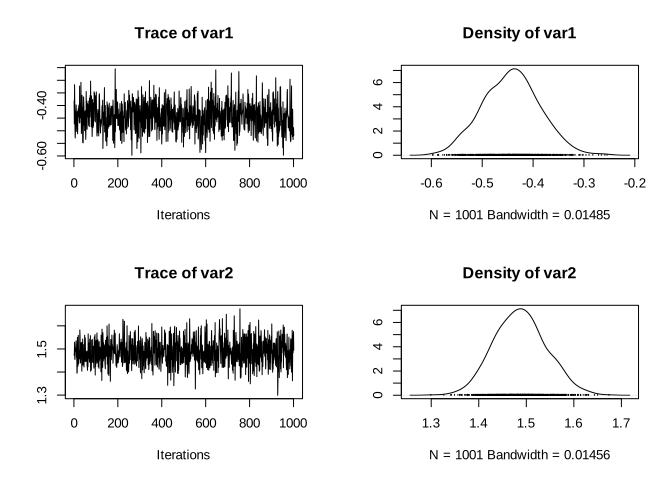
PosteriorPsi <- PostPsi[keep,]
Clusters <- sapply(1:length(keep), function(i){length(table(PosteriorPsi[i,]))})
NClus <- 2
PosteriorSIGMA <- matrix(NA, length(keep), NClus)
PosteriorMU <- matrix(NA, length(keep), NClus)
PosteriorLAMBDA <- matrix(NA, length(keep), NClus)
l <- 1
for (s in keep){
    PosteriorSIGMA[l,] <- PostSigma2[[s]][1:NClus]
    PosteriorMU[l,] <- PostMu[[s]][1:NClus]
    PosteriorLAMBDA[l,] <- PostLambda[[s]][1:NClus]
    l <- l + 1
}

summary(coda::mcmc(PosteriorSIGMA))
##
## Iterations = 1:1001
## Thinning interval = 1
## Number of chains = 1
## Sample size per chain = 1001
##
## 1. Empirical mean and standard deviation for each variable,
## plus standard error of the mean:
##
## Mean SD Naive SE Time-series SE
## [1,] 0.9544 0.1232 0.003892 0.008764
## [2,] 9.6460 2.3282 0.073588 0.199682
##
## 2. Quantiles for each variable:
##
## 2.5% 25% 50% 75% 97.5%
## var1 0.7384 0.8677 0.9497 1.035 1.207
## var2 6.3002 8.0097 9.3242 10.800 15.502##
## Iterations = 1:1001
## Thinning interval = 1
## Number of chains = 1
## Sample size per chain = 1001
##
## 1. Empirical mean and standard deviation for each variable,
## plus standard error of the mean:
##
## Mean SD Naive SE Time-series SE
## [1,] 0.9668 0.05966 0.001886 0.002215
## [2,] 1.1033 0.34621 0.010943 0.011769
##
## 2. Quantiles for each variable:
##
## 2.5% 25% 50% 75% 97.5%
## var1 0.8559 0.9259 0.9636 1.008 1.089
## var2 0.4583 0.8649 1.0891 1.332 1.802##
## Iterations = 1:1001
## Thinning interval = 1
## Number of chains = 1
## Sample size per chain = 1001
##
## 1. Empirical mean and standard deviation for each variable,
## plus standard error of the mean:
##
## Mean SD Naive SE Time-series SE
## [1,] 0.8012 0.04709 0.001488 0.004693
## [2,] 0.1988 0.04709 0.001488 0.004693
##
## 2. Quantiles for each variable:
##
## 2.5% 25% 50% 75% 97.5%
## var1 0.7025 0.7701 0.8039 0.8342 0.8863
## var2 0.1137 0.1658 0.1961 0.2299 0.297511.1.2 Direchlet processes
A Dirichlet process (DP) is a probability distribution over probability distributions, and a generalization of the Dirichlet distribution. It was introduced by Ferguson (1973), and it is commonly used as a prior for unknown distributions, making it particularly useful in non-parametric settings. Unlike finite Gaussian mixture models, a Dirichlet process does not require pre-specifying the number of components, allowing for greater flexibility in modeling complex data structures. In this sense, DPs can be viewed as the limiting case of finite mixtures when the number of components approaches infinity.
A Dirichlet process \(G\sim DP(\alpha G_0)\) is defined by a precision parameter \(\alpha>0\), and a base probability measure \(G_0\) on a probability space \(\Omega\).68 The DP assigns probability \(G(B)\) to any (measurable) set \(B\) in \(\Omega\) such that for any finite (measurable) partition \(\left\{B_1, B_2, \dots, B_k\right\}\) of \(\Omega\),
\[ G(B_1), G(B_2), \dots, G(B_k) \sim \text{Dirichlet}(\alpha G_0(B_1), \alpha G_0(B_2), \dots, \alpha G_0(B_k)). \]
In particular, \(\mathbb{E}\left[G(B)\right]=G_0(B)\) and \(\mathbb{V}ar\left[G(B)\right]=G_0(B)\left[1-G_0(B)\right]/(1+\alpha)\) (P. Müller et al. 2015). Observe that as \(\alpha \rightarrow \infty\), \(G\) concentrates at \(G_0\), which is why \(\alpha\) is called the precision parameter.
A key property of the DP is its discrete nature, which allows it to be expressed as
\[
G(\cdot)=\sum_{h=1}^{\infty}\lambda_h\delta_{\boldsymbol{\theta}_h}(\cdot),
\]
where \(\lambda_h\) is the probability mass at \(\boldsymbol{\theta}_h\), and \(\delta_{\boldsymbol{\theta}_h}(\cdot)\) denotes the Dirac measure that assigns mass one to the atom \(\boldsymbol{\theta}_h\).69 Given this property, a particularly useful construction of the DP is the stick-breaking representation (Sethuraman 1994), which is given by
\[\begin{align*}
G(\cdot)&=\sum_{h=1}^{\infty}\lambda_h\delta_{\boldsymbol{\theta}_h}(\cdot),\\
\lambda_h&=V_h\prod_{m<h}(1-V_m), \quad V_h\sim \text{Beta}(1,\alpha),\\
\boldsymbol{\theta}_h&\stackrel{iid}{\sim} G_0.
\end{align*}\]
The intuition behind this representation is straightforward. We begin with a stick of length 1 and break off a random proportion \(V_1\) drawn from a \(\text{Beta}(1,\alpha)\) distribution. This assigns a probability mass of \(\lambda_1=V_1\) to \(\boldsymbol{\theta}_1\), which is sampled from \(G_0\). Next, from the remaining stick of length \((1-V_1)\), we break off a fraction proportional to \(V_2 \sim \text{Beta}(1,\alpha)\), assigning a probability mass of \(\lambda_2=V_2(1-V_1)\) to a new draw \(\boldsymbol{\theta}_2\) from \(G_0\). This process continues indefinitely.
Since \(\mathbb{E}(V_h) = \frac{1}{1+\alpha}\), as \(\alpha \rightarrow \infty\), we have \(\mathbb{E}(V_h) \rightarrow 0\). Consequently, the DP places mass on a large number of atoms, leading to convergence to the base distribution \(G_0\).
Note that DPs give as realizations discrete distributions, this poses challenges when working with continuous distributions. One way to overcome this limitation is to use the DP as a mixing distribution for simple parametric distributions, such as the normal distribution (Escobar and West 1995). This leads to Dirichlet process mixtures (DPM), which are defined as
\[\begin{align*}
f_G(y) &= \int f_{\boldsymbol{\theta}}(y) dG(\boldsymbol{\theta}).
\end{align*}\]
Observe that the mixing measure \(G\) is discrete when a DP is the prior, with mass concentrated at an infinite number of atoms \(\boldsymbol{\theta}_h\). Consequently, if \(f_{\boldsymbol{\theta}}(y)\) follows a Gaussian distribution, the resulting mixture resembles a finite Gaussian mixture. However, unlike finite mixtures, the DP-based approach eliminates the need to pre-specify the number of components, as it provides an automatic mechanism for determining them.
Thus, if we assume \(y\sim N(\boldsymbol{x}_i^{\top}\boldsymbol{\beta},\sigma^2)\), then the DPM is \[ p(y_i \mid \{\lambda_h, \boldsymbol{\beta}_h, \sigma_h^2\}_{h=1}^{\infty}, \boldsymbol{x}_i) = \sum_{h=1}^{\infty} \lambda_h \phi(y_i \mid \boldsymbol{x}_i^{\top}\boldsymbol{\beta}_h, \sigma_h^2), \] where \(\lambda_h\) are drawn from the stick-breaking representation of the DP, and \(\boldsymbol{\theta}_h=[\boldsymbol{\beta}_h^{\top} \ \sigma^2_h]^{\top}\).
This mixture model can be expressed in a hierarchical structure: \[\begin{align*} y_i\mid \boldsymbol{\theta}_i & \stackrel{ind}{\sim}f_{\boldsymbol{\theta}_i}\\ \boldsymbol{\theta}_i \mid G & \stackrel{iid}{\sim} G\\ G \mid \alpha,G_0 & \sim DP(\alpha G_0). \end{align*}\]
Note that the hierarchical representation induces specific unit parameters, leading to a probabilistic clustering model (Antoniak 1974), similar to a finite Gaussian mixture. However, the DPM is not consistent in estimating the number of clusters, it tends to overestimate the number of clusters (see simulation exercise below); although there is posterior asymptotic concentration in the other model components (Miller and Harrison 2014).
The hierarchical representation implies that there are latent assignment variables \(s_i = h\), such that when \(\boldsymbol{\theta}_i\) is equal to the \(h\)-th unique \(\boldsymbol{\theta}_h^*\) — that is, \(\boldsymbol{\theta}_i = \boldsymbol{\theta}_h^*\)— then \(s_i = h\). Then, \[\begin{align*} s_i&\sim \sum_{h=0}^{\infty}\lambda_h\delta_h,\\ y_i\mid s_i, \boldsymbol{\theta}_{s_i}&\sim N(\boldsymbol{x}_i^{\top}\boldsymbol{\beta}_{s_i},\sigma^2_{s_i}), \end{align*}\] where \(\lambda_h=P(\boldsymbol{\theta}_{i}=\boldsymbol{\theta}_{h}^*)\).
This latent assignment structure, the Pólya urn representation of the DP (Blackwell and MacQueen 1973), which is obtained when \(G\) is marginalized out to avoid infinite atoms, and the use of conjugate priors allow for convenient computational inference in DPM.
Specifically, we assume \(\boldsymbol{\beta}_i\mid \sigma^2_i\sim N(\boldsymbol{\beta}_0, \sigma^2_i\boldsymbol{B}_0)\) and \(\sigma_i^2\sim IG(\alpha_0/2,\delta_0/2)\). In addition, we can add a layer in the hierarchical representation, \(\alpha\sim G(a,b)\) such that introducing the latent variable \(\xi|\alpha,N\sim Be(\alpha+1,N)\), allows to easily sample the posterior draws of \(\alpha|\xi,H,\pi_{\xi}\sim\pi_{\xi}{G}(a+H,b-log(\xi))+(1-\pi_{\xi}){G}(a+H-1,b-log(\xi))\), where \(\frac{\pi_{\xi}}{1-\pi_{\xi}}=\frac{a+H-1}{N(b-log(\xi))}\), \(H\) is the number of atoms (mixture components) (Escobar and West 1995).
The conditional posterior distribution of \(\boldsymbol\theta_i\) is \[\begin{align*} \boldsymbol\theta_i|\left\{\boldsymbol\theta_{i'},\boldsymbol s_{i'}:i'\neq i\right\}, y_i, \alpha & \sim \sum_{i'\neq i}\frac{N_h^{(i)}}{\alpha+N-1}f_N(y_i|\boldsymbol{x}_i^{\top}\boldsymbol{\beta}_h,\sigma_h^2)\\ & +\frac{\alpha}{\alpha+N-1}\int_{\mathcal{R}^K}\int_{0}^{\infty}f_N(y_i|\boldsymbol{x}_i^{\top}\boldsymbol{\beta},\sigma^2)\\ &\times f_N\left(\boldsymbol\beta\Big|\boldsymbol\beta_0,\sigma^2\boldsymbol B_0\right)f_{IG}(\sigma^2|\alpha_0,\delta_0)d\sigma^2 d\boldsymbol\beta, \end{align*}\] where \(N_h^{(i)}\) is the number of observations such that \(s_{i'}=h\), \(i'\neq i\).
Observe that the probability of belonging to a particular cluster has a reinforcement property, as it increases with the cluster size; therefore, a DPM exhibits a self-reinforcing property, the more often a given value has been sampled in the past, the more likely it is to be sampled again.
Observe that the integral in the previous equation has exactly the same form as in the marginal likelihood presented in Section 3.3. Thus, \[\begin{align*} p(y_i)&=\int_{\mathcal{R}^K}\int_{0}^{\infty}f_N(y_i|\boldsymbol{x}_i^{\top}\boldsymbol{\beta},\sigma^2)f_N\left(\boldsymbol\beta\Big|\boldsymbol\beta_0,\sigma^2\boldsymbol B_0\right)f_{IG}(\sigma^2|\alpha_0,\delta_0)d\sigma^2 d\boldsymbol\beta\\ &=\frac{1}{\pi^{1/2}}\frac{\delta_0^{\alpha_0/2}}{\delta_n^{\alpha_n/2}}\frac{|{\boldsymbol{B}}_n|^{1/2}}{|{\boldsymbol{B}}_0|^{1/2}}\frac{\Gamma(\alpha_n/2)}{\Gamma(\alpha_0/2)}, \end{align*}\] where \(\alpha_n=1+\alpha_0\), \(\delta_n=\delta_0 + y_i^2 + \boldsymbol{\beta}_0^{\top}{\boldsymbol{B}}_0^{-1}\boldsymbol{\beta}_0 - \boldsymbol{\beta}_n^{\top}{\boldsymbol{B}}_n^{-1}\boldsymbol{\beta}_n\), \(\boldsymbol{B}_n = (\boldsymbol{B}_0^{-1} + \boldsymbol{x}_i\boldsymbol{x}_i^{\top})^{-1}\) and \(\boldsymbol{\beta}_n = \boldsymbol{B}_n(\boldsymbol{B}_0^{-1}\boldsymbol{\beta}_0 + \boldsymbol{x}_iy_i)\).
Therefore, we sample \(s_i\) as follows, \[\begin{equation*} s_i|\left\{\boldsymbol\beta_{i'},\sigma_{i'}^2,\boldsymbol s_{i'}:i'\neq i\right\}, y_i, \alpha\sim\begin{Bmatrix}P(s_i=0|\cdot)=q_0^*\\ P(s_i=h|\cdot)=q_h^*, h=1,2,\dots,H^{(i)}\end{Bmatrix}, \end{equation*}\]
where \(H^{(i)}\) is the number of clusters excluding \(i\), which may have its own cluster (singleton cluster), \(q^*_c=\frac{q_c}{q_0+\sum_h q_h}\), \(q_c=\left\{q_0,q_h\right\}\), \(q_h=\frac{N_h^{(i)}}{\alpha+N-1}f_N(y_i|\boldsymbol{x}_i^{\top}\boldsymbol\beta_h,\sigma_h^2)\) and \(q_0=\frac{\alpha}{\alpha+N-1}p(y_i)\).
If \(s_i=0\) is sampled, then \(s_i=H+1\), and a new \(\sigma_h^2\) is sampled from \(IG\left(\alpha_n/2,\delta_n/2\right)\), a new \(\boldsymbol\beta_h\) is sample from \(N(\boldsymbol\beta_n,\sigma_h^2\boldsymbol B_n)\).
Discarding \(\boldsymbol\theta_h\)’s from last step, we use \(\boldsymbol s\) and the total number of components to sample \(\sigma_h^2\) from
\[\begin{equation*} IG\left(\frac{\alpha_0+N_m}{2},\frac{\delta_0+\boldsymbol y_h^{\top}\boldsymbol y_h+\boldsymbol{\beta}_0^{\top}{\boldsymbol{B}}_0^{-1}\boldsymbol{\beta}_0-\boldsymbol{\beta}_{hn}^{\top}{\boldsymbol{B}}_{hn}^{-1}\boldsymbol{\beta}_{hn}}{2}\right), \end{equation*}\]
where \(\boldsymbol{B}_{hn}=(\boldsymbol{B}_0^{-1}+\boldsymbol{X}_h^{\top}\boldsymbol{X}_h)^{-1}\) and \(\boldsymbol{\beta}_{hn}=\boldsymbol{B}_{hn}(\boldsymbol{B}_0^{-1}\boldsymbol{\beta}_0+\boldsymbol{X}_h^{\top}\boldsymbol{y}_h)\), \(\boldsymbol{X}_h\) and \(\boldsymbol{y}_h\) have the \(\boldsymbol{x}_i\) and \(y_i\) of individuals in component \(h\). We sample \(\boldsymbol\beta_h\) from \[\begin{equation*} N\left({\boldsymbol\beta}_{hn},\sigma_h^2\boldsymbol B_{hn}\right), \end{equation*}\] \(h=1,2,\dots,H\).
We can also use DPMs in a semi-parametric setting, as we did in the finite Gaussian mixtures case. In Exercise 3, we ask to get the posterior sampler in this setting, that is, \[\begin{align*} y_i&=\boldsymbol{x}_i^{\top}\boldsymbol{\beta}+e_i\\ e_i\mid \mu_i,\sigma_i^2 &\stackrel{iid}{\sim} N(\mu_i,\sigma_i^2). \end{align*}\] We should not include the intercept in \(\boldsymbol{\beta}\), such that \(\mu_i\) allows to get flexibility in the distribution of the stochastic errors.
Note that mixture models can be easily extended to non-linear models, where posterior inference is based on data augmentation, such as the probit and tobit models in Chapter 6. The basic idea is to incorporate the mixture (finite or infinite) into the specification of the latent variable implicit in the data-generating process. For instance, Basu and Chib (2003) perform inference in the probit model using DPMs. Furthermore, mixtures can also be used in the multivariate models presented in Chapter 7 and the hierarchical models presented in Chapter 9. Ramı́rez–Hassan and López-Vera (2024) perform semi-parametric inference in the exact affine demand system (Lewbel and Pendakur 2009) using DPMs, while Basu and Chib (2003) apply them in hierarchical models.
To sum up, a Dirichlet process mixture is a flexible way to model non-parametrically a distribution using an infinite weighted sum of discrete distributions, where each individual weight increases with the number of observations that belongs to it.
Example: Simulation exercises
Let’s simulate again the simple regression mixture with two components such that \(\psi_{i1}\sim \text{Ber}(0.5)\), consequently, \(\psi_{i2}=1-\psi_{i1}\), and assume one regressor, \(x_i\sim N(0,1)\), \(i=1,2,\dots,1,000\). Then, \[p(y_i \mid \boldsymbol{x}_i) = 0.5 \phi(y_i \mid 2+1.5x_i,1^2)+0.5 \phi(y_i \mid -1+0.5x_i,0.8^2).\]
We use non-informative priors again, setting \(\alpha_{0}=\delta_{0}=0.01\), \(\boldsymbol{\beta}_{0}=\boldsymbol{0}_2\), \(\boldsymbol{B}_{0}=\boldsymbol{I}_2\), and \(a=b=0.1\). The number of MCMC iterations is 5,000, the burn-in is 1,000, and the thinning parameter is 2. However, we do not have to fix in advance the number of clusters using the DPM.
The following code demonstrates how to perform inference using the stated Gibbs sampler for the DPM in the R package.
We see from the results that the DPM overestimates the number of clusters. After the burn-in period, there are typically three clusters. Additionally, the posterior plots illustrate the label-switching problem. Eventually, the posterior chains of clusters reach different posterior modes, causing a high variability of the posterior draws. In Exercise 5, we ask to fix this issue using random permutation of latent classes.
rm(list = ls())
set.seed(10101)
# Simulate data from a 2-component mixture model
N <- 1000; x <- rnorm(N); z <- rbinom(N, 1, 0.5)
y <- ifelse(z == 1, rnorm(N, 2 + 1.5*x, 1), rnorm(N, -1 + 0.5*x, 0.8))
X <- cbind(1, x)
k <- 2
data <- data.frame(y, x); Reg <- lm(y ~ x)
SumReg <- summary(Reg)
# Hyperparameters
a0 <- 0.001; d0 <- 0.001
b0 <- rep(0, k); B0 <- diag(k)
B0i <- solve(B0)
a <- 0.1; b <- 0.1
# MCMC parameters
mcmc <- 5000; burnin <- 1000
tot <- mcmc + burnin; thin <- 2
# Gibbs sampling functions
PostSig2 <- function(Xh, yh){
    Nh <- length(yh)
    yh <- matrix(yh, Nh, 1)
    if(Nh == 1){
        Xh <- matrix(Xh, k, 1)
        Bn <- solve(Xh%*%t(Xh) + B0i)
        bn <- Bn%*%(B0i%*%b0 + Xh%*%yh)
    }else{
        Xh <- matrix(Xh, Nh, k)
        Bn <- solve(t(Xh)%*%Xh + B0i)
        bn <- Bn%*%(B0i%*%b0 + t(Xh)%*%yh)
    }
    Bni <- solve(Bn)
    an <- a0 + Nh
    dn <- d0 + t(yh)%*%yh + t(b0)%*%B0i%*%b0 - t(bn)%*%Bni%*%bn
    sig2 <- invgamma::rinvgamma(1, shape = an/2, rate = dn/2)
    return(sig2)
}
PostBeta <- function(sig2h, Xh, yh){
    Nh <- length(yh)
    yh <- matrix(yh, Nh, 1)
    if(Nh == 1){
        Xh <- matrix(Xh, k, 1)
        Bn <- solve(Xh%*%t(Xh) + B0i)
        bn <- Bn%*%(B0i%*%b0 + Xh%*%yh)
    }else{
        Xh <- matrix(Xh, Nh, k)
        Bn <- solve(t(Xh)%*%Xh + B0i)
        bn <- Bn%*%(B0i%*%b0 + t(Xh)%*%yh)
    }
    Beta <- MASS::mvrnorm(1, bn, sig2h*Bn)
    return(Beta)
}
PostAlpha <- function(s, alpha){
    H <- length(unique(s))
    psi <- rbeta(1, alpha + 1, N)
    pi.ratio <- (a + H - 1) / (N * (b - log(psi)))
    pi <- pi.ratio / (1 + pi.ratio)
    components <- sample(1:2, prob = c(pi, (1 - pi)), size = 1)
    cs <- c(a + H, a + H - 1)
    ds <- b - log(psi)
    alpha <- rgamma(1, cs[components], ds)
    return(alpha)
}
LogMarLikLM <- function(xh, yh){
    xh <- matrix(xh, k, 1)
    Bn <- solve(xh%*%t(xh) + B0i)
    Bni <- solve(Bn)
    bn <- Bn%*%(B0i%*%b0 + xh%*%yh)
    an <- a0 + 1
    dn <- d0 + yh^2 + t(b0)%*%B0i%*%b0 - t(bn)%*%Bni%*%bn
    # Log marginal likelihood
    logpy <- (1/2)*log(1/pi)+(a0/2)*log(d0)-(an/2)*log(dn) + 0.5*log(det(Bn)/det(B0)) + lgamma(an/2)-lgamma(a0/2)
    return(logpy)
}
PostS <- function(BETA, SIGMA, Alpha, s, i){
    Nl <- table(s[-i]); H <- length(Nl)
    qh <- sapply(1:H, function(h){(Nl[h]/(N+Alpha-1))*dnorm(y[i], mean = t(X[i,])%*%BETA[,h], sd = SIGMA[h])})
    q0 <- (Alpha/(N+Alpha-1))*exp(LogMarLikLM(xh = X[i,], yh = y[i]))
    qh <- c(q0, qh)
    Clust <- as.numeric(names(Nl))
    si <- sample(c(0, Clust), 1, prob = qh)
        if(si == 0){
            si <- Clust[H] + 1
            Sig2New <- PostSig2(Xh = X[i,], yh = y[i])
            SIGMA <- c(SIGMA, Sig2New^0.5)
            BetaNew <- PostBeta(sig2h = Sig2New, Xh = X[i,], yh = y[i])
            BETA <- cbind(BETA, BetaNew)
        }else{si == si
        }
        return(list(si = si, BETA = BETA, SIGMA = SIGMA))
    }
PostBetas <- list(); PostSigma <- list()
Posts <- matrix(0, tot, N); PostAlphas <- rep(0, tot)
S <- sample(1:3, N, replace = T, prob = c(0.5, 0.3, 0.2))
BETA <- cbind(Reg$coefficients, Reg$coefficients, Reg$coefficients)
SIGMA <- rep(SumReg$sigma, 3)
Alpha <- rgamma(1, a, b)
pb <- txtProgressBar(min = 0, max = tot, style = 3)
## | | | 0%for(s in 1:tot){
for(i in 1:N){
Rests <- PostS(BETA = BETA, SIGMA = SIGMA, Alpha = Alpha, s = S, i = i)
S[i] <- Rests$si
BETA <- Rests$BETA; SIGMA <- Rests$SIGMA
}
sFreq <- table(S)
lt <- 1
for(li in as.numeric(names(sFreq))){
Index <- which(S == li)
if(li == lt){S[Index] <- li
} else {S[Index] <- lt
}
lt <- lt + 1
}
Alpha <- PostAlpha(s = S, alpha = Alpha)
Nl <- table(S); H <- length(Nl)
SIGMA <- rep(NA, H)
BETA <- matrix(NA, k, H)
l <- 1
for(h in unique(S)){
Idh <- which(S == h)
SIGMA[l] <- (PostSig2(Xh = X[Idh, ], yh = y[Idh]))^0.5
BETA[,l] <- PostBeta(sig2h = SIGMA[l]^2, Xh = X[Idh, ], yh = y[Idh])
l <- l + 1
}
PostBetas[[s]] <- BETA
PostSigma[[s]] <- SIGMA
Posts[s, ] <- S
PostAlphas[s] <- Alpha
setTxtProgressBar(pb, s)
}## | | | 1% | |= | 1% | |= | 2% | |== | 2% | |== | 3% | |== | 4% | |=== | 4% | |=== | 5% | |==== | 5% | |==== | 6% | |===== | 6% | |===== | 7% | |===== | 8% | |====== | 8% | |====== | 9% | |======= | 9% | |======= | 10% | |======= | 11% | |======== | 11% | |======== | 12% | |========= | 12% | |========= | 13% | |========= | 14% | |========== | 14% | |========== | 15% | |=========== | 15% | |=========== | 16% | |============ | 16% | |============ | 17% | |============ | 18% | |============= | 18% | |============= | 19% | |============== | 19% | |============== | 20% | |============== | 21% | |=============== | 21% | |=============== | 22% | |================ | 22% | |================ | 23% | |================ | 24% | |================= | 24% | |================= | 25% | |================== | 25% | |================== | 26% | |=================== | 26% | |=================== | 27% | |=================== | 28% | |==================== | 28% | |==================== | 29% | |===================== | 29% | |===================== | 30% | |===================== | 31% | |====================== | 31% | |====================== | 32% | |======================= | 32% | |======================= | 33% | |======================= | 34% | |======================== | 34% | |======================== | 35% | |========================= | 35% | |========================= | 36% | |========================== | 36% | |========================== | 37% | |========================== | 38% | |=========================== | 38% | |=========================== | 39% | |============================ | 39% | |============================ | 40% | |============================ | 41% | |============================= | 41% | |============================= | 42% | |============================== | 42% | |============================== | 43% | |============================== | 44% | |=============================== | 44% | |=============================== | 45% | |================================ | 45% | |================================ | 46% | |================================= | 46% | |================================= | 47% | |================================= | 48% | |================================== | 48% | |================================== | 49% | |=================================== | 49% | |=================================== | 50% | |=================================== | 51% | |==================================== | 51% | |==================================== | 52% | |===================================== | 52% | |===================================== | 53% | |===================================== | 54% | |====================================== | 54% | |====================================== | 55% | |======================================= | 55% | |======================================= | 56% | |======================================== | 56% | |======================================== | 57% | |======================================== | 58% | |========================================= | 58% | |========================================= | 59% | |========================================== | 59% | |========================================== | 60% | |========================================== | 61% | |=========================================== | 61% | |=========================================== | 62% | |============================================ | 62% | |============================================ | 63% | |============================================ | 64% | |============================================= | 64% | |============================================= | 65% | |============================================== | 65% | |============================================== | 66% | |=============================================== | 66% | |=============================================== | 67% | |=============================================== | 68% | |================================================ | 68% | |================================================ | 69% | |================================================= | 69% | |================================================= | 70% | |================================================= | 71% | |================================================== | 71% | |================================================== | 72% | |=================================================== | 72% | |=================================================== | 73% | |=================================================== | 74% | |==================================================== | 74% | |==================================================== | 75% | |===================================================== | 75% | |===================================================== | 76% | |====================================================== | 76% | |====================================================== | 77% | |====================================================== | 78% | |======================================================= | 78% | |======================================================= | 79% | |======================================================== | 79% | |======================================================== | 80% | |======================================================== | 81% | |========================================================= | 81% | |========================================================= | 82% | |========================================================== | 82% | |========================================================== | 83% | |========================================================== | 84% | |=========================================================== | 84% | |=========================================================== | 85% | |============================================================ | 85% | |============================================================ | 86% | |============================================================= | 86% | |============================================================= | 87% | |============================================================= | 88% | |============================================================== | 88% | |============================================================== | 89% | |=============================================================== | 89% | |=============================================================== | 90% | |=============================================================== | 91% | |================================================================ | 91% | |================================================================ | 92% | |================================================================= | 92% | |================================================================= | 93% | |================================================================= | 94% | |================================================================== | 94% | |================================================================== | 95% | |=================================================================== | 95% | |=================================================================== | 96% | |==================================================================== | 96% | |==================================================================== | 97% | |==================================================================== | 98% | |===================================================================== | 98% | |===================================================================== | 99% | |======================================================================| 99% | |======================================================================| 100%keep <- seq((burnin+1), tot, thin)
PosteriorS<- Posts[keep,]
Clusters <- sapply(1:length(keep), function(i){length(table(PosteriorS[i,]))})
table(Clusters)## Clusters
## 2 3
## 2495 5PosteriorBeta1 <- matrix(NA, length(keep), k); j <- 1
for(s in keep){
PosteriorBeta1[j,] <- PostBetas[[s]][,1]; j <- j + 1
}
print(summary(coda::mcmc(PosteriorBeta1)))##
## Iterations = 1:2500
## Thinning interval = 1
## Number of chains = 1
## Sample size per chain = 2500
##
## 1. Empirical mean and standard deviation for each variable,
## plus standard error of the mean:
##
## Mean SD Naive SE Time-series SE
## [1,] -0.7081 0.9286 0.018573 0.017838
## [2,] 0.5579 0.3161 0.006323 0.006037
##
## 2. Quantiles for each variable:
##
## 2.5% 25% 50% 75% 97.5%
## var1 -1.1134 -1.0545 -1.0229 -0.9846 2.018
## var2 0.3601 0.4242 0.4571 0.4941 1.499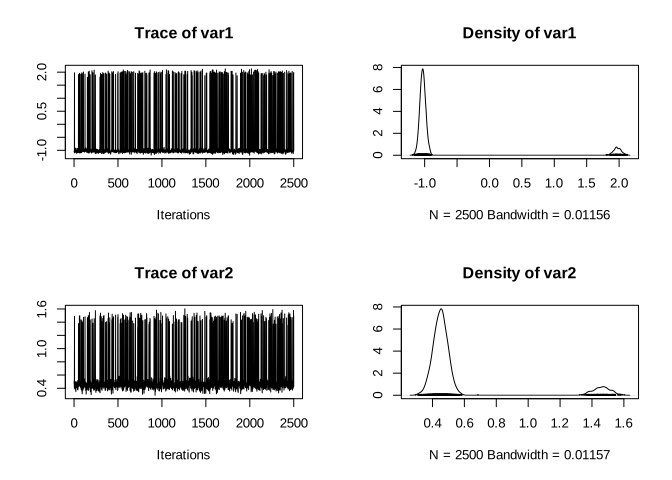
PosteriorBeta2 <- matrix(NA, length(keep), k);j <- 1
for(s in keep){
    PosteriorBeta2[j,] <- PostBetas[[s]][,2]; j <- j + 1
}
print(summary(coda::mcmc(PosteriorBeta2)))
##
## Iterations = 1:2500
## Thinning interval = 1
## Number of chains = 1
## Sample size per chain = 2500
##
## 1. Empirical mean and standard deviation for each variable,
## plus standard error of the mean:
##
## Mean SD Naive SE Time-series SE
## [1,] 1.658 0.9331 0.018663 0.017968
## [2,] 1.349 0.3169 0.006337 0.006026
##
## 2. Quantiles for each variable:
##
## 2.5% 25% 50% 75% 97.5%
## var1 -1.0715 1.921 1.971 2.016 2.095
## var2 0.4158 1.403 1.450 1.489 1.553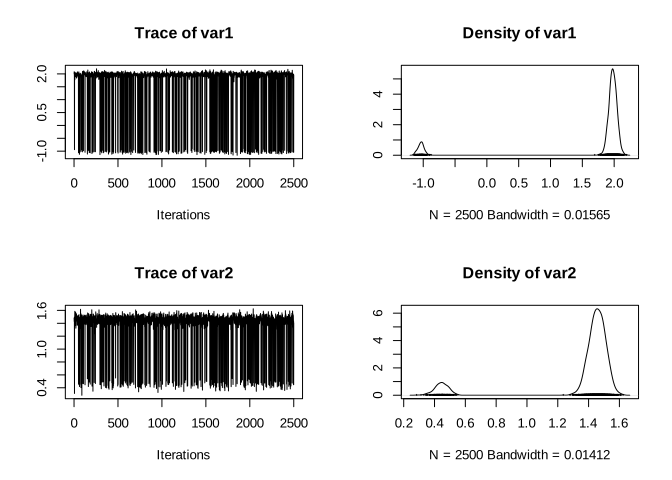
# # If there are 3 clusters
# PosteriorBeta3 <- matrix(NA, length(keep), k); j <- 1
# for(s in keep){
#   PosteriorBeta3[j,] <- PostBetas[[s]][,3]; j <- j + 1
# }
# print(summary(coda::mcmc(PosteriorBeta3)))
# plot(coda::mcmc(PosteriorBeta3))
Example: Consumption of marijuana in Colombia
Let’s use the dataset MarijuanaColombia.csv from our GitHub repository to perform inference on the demand for marijuana in Colombia. This dataset contains information on the (log) monthly demand in 2019 from the National Survey of the Consumption of Psychoactive Substances. It includes variables such as the presence of a drug dealer in the neighborhood (Dealer), gender (Female), indicators of good physical and mental health (PhysicalHealthGood and MentalHealthGood), age (Age and Age2), years of schooling (YearsEducation), and (log) prices of marijuana, cocaine, and crack by individual (LogPriceMarijuana, LogPriceCocaine, and LogPriceCrack). The sample size is 1,156.
We are interested in the own-price and cross-price elasticities of marijuana demand. However, there is a potential endogeneity issue between price and demand due to strategic provider search (omission of a relevant regressor) or measurement errors in self-reported prices. Endogeneity should be properly addressed for rigorous scientific analysis. This example is purely illustrative.
In Exercise 2 we ask to perform inference using a finite Gaussian mixture regression starting with five potential clusters. Here we perform inference using a Dirichlet process mixture.
The following code shows how to perform this analysis using non-informative priors, setting \(\alpha_{0}=\delta_{0}=0.01\), \(\boldsymbol{\beta}_{0}=\boldsymbol{0}_K\), \(\boldsymbol{B}_{0}=\boldsymbol{I}_K\), and \(a=b=0.1\), \(K\) is the number of regressors, 11 including the intercept. The number of MCMC iterations is 5,000, the burn-in is 1,000, and the thinning parameter is 2.
rm(list = ls()); set.seed(010101)
Data <- read.csv("https://raw.githubusercontent.com/BEsmarter-consultancy/BSTApp/refs/heads/master/DataApp/MarijuanaColombia.csv")
attach(Data)
## The following object is masked from Data (pos = 5):
##
## Age## The following objects are masked from Data (pos = 13):
##
## Age, Female## The following objects are masked from Data (pos = 17):
##
## Age, Age2## The following objects are masked from Data (pos = 18):
##
## Age, Age2## The following objects are masked from Data (pos = 19):
##
## Age, Age2, Female## The following objects are masked from mydata:
##
## Age, Age2, Female## The following objects are masked from Data (pos = 21):
##
## Age, Age2y <- LogMarijuana; X <- as.matrix(cbind(1, Data[,-1]))
Reg <- lm(y ~ X - 1); SumReg <- summary(Reg)
k <- dim(X)[2]
N <- dim(X)[1]
library(ggplot2)
ggplot(Data, aes(x = LogMarijuana)) + geom_density(fill = "blue", alpha = 0.3) + labs(title = "Density Plot: Marijuana (log) monthly consumption in Colombia", x = "y", y = "Density") + theme_minimal()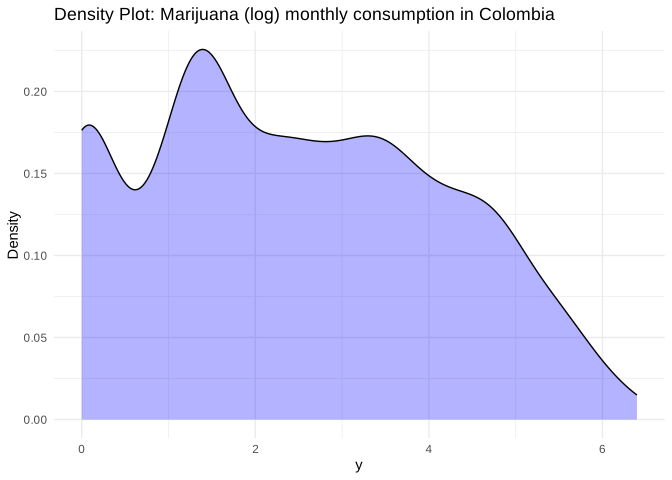
a0 <- 0.001; d0 <- 0.001
b0 <- rep(0, k); B0 <- diag(k)
B0i <- solve(B0)
a <- 0.1; b <- 0.1
# MCMC parameters
mcmc <- 5000; burnin <- 1000
tot <- mcmc + burnin; thin <- 2
# Gibbs sampling functions
PostSig2 <- function(Xh, yh){
    Nh <- length(yh)
    yh <- matrix(yh, Nh, 1)
    if(Nh == 1){
        Xh <- matrix(Xh, k, 1)
        Bn <- solve(Xh%*%t(Xh) + B0i)
        bn <- Bn%*%(B0i%*%b0 + Xh%*%yh)
    }else{
        Xh <- matrix(Xh, Nh, k)
        Bn <- solve(t(Xh)%*%Xh + B0i)
        bn <- Bn%*%(B0i%*%b0 + t(Xh)%*%yh)
    }
    Bni <- solve(Bn)
    an <- a0 + Nh
    dn <- d0 + t(yh)%*%yh + t(b0)%*%B0i%*%b0 - t(bn)%*%Bni%*%bn
    sig2 <- invgamma::rinvgamma(1, shape = an/2, rate = dn/2)
    return(sig2)
}
PostBeta <- function(sig2h, Xh, yh){
    Nh <- length(yh)
    yh <- matrix(yh, Nh, 1)
    if(Nh == 1){
        Xh <- matrix(Xh, k, 1)
        Bn <- solve(Xh%*%t(Xh) + B0i)
        bn <- Bn%*%(B0i%*%b0 + Xh%*%yh)
    }else{
        Xh <- matrix(Xh, Nh, k)
        Bn <- solve(t(Xh)%*%Xh + B0i)
        bn <- Bn%*%(B0i%*%b0 + t(Xh)%*%yh)
    }
    Beta <- MASS::mvrnorm(1, bn, sig2h*Bn)
    return(Beta)
}
PostAlpha <- function(s, alpha){
    H <- length(unique(s))
    psi <- rbeta(1, alpha + 1, N)
    pi.ratio <- (a + H - 1) / (N * (b - log(psi)))
    pi <- pi.ratio / (1 + pi.ratio)
    components <- sample(1:2, prob = c(pi, (1 - pi)), size = 1)
    cs <- c(a + H, a + H - 1)
    ds <- b - log(psi)
    alpha <- rgamma(1, cs[components], ds)
    return(alpha)
}
LogMarLikLM <- function(xh, yh){
    xh <- matrix(xh, k, 1)
    Bn <- solve(xh%*%t(xh) + B0i)
    Bni <- solve(Bn)
    bn <- Bn%*%(B0i%*%b0 + xh%*%yh)
    an <- a0 + 1
    dn <- d0 + yh^2 + t(b0)%*%B0i%*%b0 - t(bn)%*%Bni%*%bn
    logpy <- (1/2)*log(1/pi)+(a0/2)*log(d0)-(an/2)*log(dn) + 0.5*log(det(Bn)/det(B0)) + lgamma(an/2)-lgamma(a0/2)
    return(logpy)
}
PostS <- function(BETA, SIGMA, Alpha, s, i){
    Nl <- table(s[-i]); H <- length(Nl)
    qh <- sapply(1:H, function(h){(Nl[h]/(N+Alpha-1))*dnorm(y[i], mean = t(X[i,])%*%BETA[,h], sd = SIGMA[h])})
    q0 <- (Alpha/(N+Alpha-1))*exp(LogMarLikLM(xh = X[i,], yh = y[i]))
    qh <- c(q0, qh)
    Clust <- as.numeric(names(Nl))
    si <- sample(c(0, Clust), 1, prob = qh)
    if(si == 0){
        si <- Clust[H] + 1
        Sig2New <- PostSig2(Xh = X[i,], yh = y[i])
        SIGMA <- c(SIGMA, Sig2New^0.5)
        BetaNew <- PostBeta(sig2h = Sig2New, Xh = X[i,], yh = y[i])
        BETA <- cbind(BETA, BetaNew)
    }else{si == si
    }
    return(list(si = si, BETA = BETA, SIGMA = SIGMA))
}
PostBetas <- list(); PostSigma <- list()
Posts <- matrix(0, tot, N); PostAlphas <- rep(0, tot)
S <- sample(1:3, N, replace = T, prob = c(0.5, 0.3, 0.2))
BETA <- cbind(Reg$coefficients, Reg$coefficients, Reg$coefficients)
SIGMA <- rep(SumReg$sigma, 3)
Alpha <- rgamma(1, a, b)
pb <- txtProgressBar(min = 0, max = tot, style = 3)
## | | | 0%for(s in 1:tot){
for(i in 1:N){
Rests <- PostS(BETA = BETA, SIGMA = SIGMA, Alpha = Alpha, s = S, i = i)
S[i] <- Rests$si
BETA <- Rests$BETA; SIGMA <- Rests$SIGMA
}
sFreq <- table(S)
lt <- 1
for(li in as.numeric(names(sFreq))){
Index <- which(S == li)
if(li == lt){S[Index] <- li
} else {S[Index] <- lt
}
lt <- lt + 1
}
Alpha <- PostAlpha(s = S, alpha = Alpha)
Nl <- table(S); H <- length(Nl)
SIGMA <- rep(NA, H)
BETA <- matrix(NA, k, H)
l <- 1
for(h in unique(S)){
Idh <- which(S == h)
SIGMA[l] <- (PostSig2(Xh = X[Idh, ], yh = y[Idh]))^0.5
BETA[,l] <- PostBeta(sig2h = SIGMA[l]^2, Xh = X[Idh, ], yh = y[Idh])
l <- l + 1
}
PostBetas[[s]] <- BETA
PostSigma[[s]] <- SIGMA
Posts[s, ] <- S
PostAlphas[s] <- Alpha
setTxtProgressBar(pb, s)
}## | | | 1% | |= | 1% | |= | 2% | |== | 2% | |== | 3% | |== | 4% | |=== | 4% | |=== | 5% | |==== | 5% | |==== | 6% | |===== | 6% | |===== | 7% | |===== | 8% | |====== | 8% | |====== | 9% | |======= | 9% | |======= | 10% | |======= | 11% | |======== | 11% | |======== | 12% | |========= | 12% | |========= | 13% | |========= | 14% | |========== | 14% | |========== | 15% | |=========== | 15% | |=========== | 16% | |============ | 16% | |============ | 17% | |============ | 18% | |============= | 18% | |============= | 19% | |============== | 19% | |============== | 20% | |============== | 21% | |=============== | 21% | |=============== | 22% | |================ | 22% | |================ | 23% | |================ | 24% | |================= | 24% | |================= | 25% | |================== | 25% | |================== | 26% | |=================== | 26% | |=================== | 27% | |=================== | 28% | |==================== | 28% | |==================== | 29% | |===================== | 29% | |===================== | 30% | |===================== | 31% | |====================== | 31% | |====================== | 32% | |======================= | 32% | |======================= | 33% | |======================= | 34% | |======================== | 34% | |======================== | 35% | |========================= | 35% | |========================= | 36% | |========================== | 36% | |========================== | 37% | |========================== | 38% | |=========================== | 38% | |=========================== | 39% | |============================ | 39% | |============================ | 40% | |============================ | 41% | |============================= | 41% | |============================= | 42% | |============================== | 42% | |============================== | 43% | |============================== | 44% | |=============================== | 44% | |=============================== | 45% | |================================ | 45% | |================================ | 46% | |================================= | 46% | |================================= | 47% | |================================= | 48% | |================================== | 48% | |================================== | 49% | |=================================== | 49% | |=================================== | 50% | |=================================== | 51% | |==================================== | 51% | |==================================== | 52% | |===================================== | 52% | |===================================== | 53% | |===================================== | 54% | |====================================== | 54% | |====================================== | 55% | |======================================= | 55% | |======================================= | 56% | |======================================== | 56% | |======================================== | 57% | |======================================== | 58% | |========================================= | 58% | |========================================= | 59% | |========================================== | 59% | |========================================== | 60% | |========================================== | 61% | |=========================================== | 61% | |=========================================== | 62% | |============================================ | 62% | |============================================ | 63% | |============================================ | 64% | |============================================= | 64% | |============================================= | 65% | |============================================== | 65% | |============================================== | 66% | |=============================================== | 66% | |=============================================== | 67% | |=============================================== | 68% | |================================================ | 68% | |================================================ | 69% | |================================================= | 69% | |================================================= | 70% | |================================================= | 71% | |================================================== | 71% | |================================================== | 72% | |=================================================== | 72% | |=================================================== | 73% | |=================================================== | 74% | |==================================================== | 74% | |==================================================== | 75% | |===================================================== | 75% | |===================================================== | 76% | |====================================================== | 76% | |====================================================== | 77% | |====================================================== | 78% | |======================================================= | 78% | |======================================================= | 79% | |======================================================== | 79% | |======================================================== | 80% | |======================================================== | 81% | |========================================================= | 81% | |========================================================= | 82% | |========================================================== | 82% | |========================================================== | 83% | |========================================================== | 84% | |=========================================================== | 84% | |=========================================================== | 85% | |============================================================ | 85% | |============================================================ | 86% | |============================================================= | 86% | |============================================================= | 87% | |============================================================= | 88% | |============================================================== | 88% | |============================================================== | 89% | |=============================================================== | 89% | |=============================================================== | 90% | |=============================================================== | 91% | |================================================================ | 91% | |================================================================ | 92% | |================================================================= | 92% | |================================================================= | 93% | |================================================================= | 94% | |================================================================== | 94% | |================================================================== | 95% | |=================================================================== | 95% | |=================================================================== | 96% | |==================================================================== | 96% | |==================================================================== | 97% | |==================================================================== | 98% | |===================================================================== | 98% | |===================================================================== | 99% | |======================================================================| 99% | |======================================================================| 100%keep <- seq((burnin+1), tot, thin)
PosteriorS<- Posts[keep,]
Clusters <- sapply(1:length(keep), function(i){length(table(PosteriorS[i,]))})
table(Clusters)## Clusters
## 3
## 2500PosteriorBeta1 <- matrix(NA, length(keep), k)
j <- 1
for(s in keep){
PosteriorBeta1[j,] <- PostBetas[[s]][,1]
j <- j + 1
}
colnames(PosteriorBeta1) <- c("Ct", names(Data[,-1]))
DataElast <- data.frame(Marijuana = PosteriorBeta1[,2], Cocaine = PosteriorBeta1[,3], Crack = PosteriorBeta1[,4])
dens1 <- ggplot(DataElast, aes(x = Marijuana)) + geom_density(fill = "blue", alpha = 0.3) + labs(x = "Marijuana", y = "Density") + theme_minimal()
dens2 <- ggplot(DataElast, aes(x = Cocaine)) + geom_density(fill = "blue", alpha = 0.3) + labs(x = "Cocaine", y = "Density") + theme_minimal()
dens3 <- ggplot(DataElast, aes(x = Crack)) + geom_density(fill = "blue", alpha = 0.3) + labs(x = "Crack", y = "Density") + theme_minimal()
library(ggpubr)
ggarrange(dens1, dens2, dens3, labels = c("A", "B", "C"), ncol = 3, nrow = 1, legend = "bottom", common.legend = TRUE)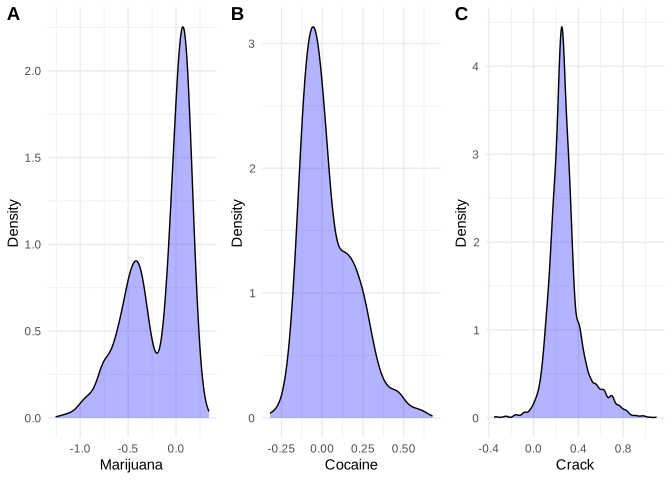
In this application, there are three clusters after the burn-in period, with individuals in the sample relatively evenly allocated between them. The posterior density plots of the elasticities associated with the three clusters appear very similar, which implies that the posterior draws associated with each cluster are targeting the same posterior distribution. Consequently, the figure presents the posterior density estimates of the demand price elasticities of marijuana in Colombia for the first cluster.
Panel A of the figure shows that the own-price elasticity of marijuana demand is bimodal. The first mode suggests that some individuals have an elasticity near -0.5, meaning that a 10% increase in the price of marijuana leads to a 5% decrease in their demand. The second mode is near 0, indicating that these individuals do not adjust their marijuana consumption in response to price changes.
Panel B presents the cross-price elasticity of marijuana demand with respect to the price of cocaine. This posterior distribution is also bimodal. The first mode suggests that some individuals do not change their marijuana demand in response to cocaine price variations. The second mode indicates that marijuana and cocaine are substitutes: a 10% increase in the price of cocaine leads to an approximately 2.5% increase in marijuana demand.
Panel C shows that marijuana and crack are also substitutes. This posterior distribution is unimodal, indicating that most individuals increase their marijuana consumption when the price of crack rises. On average, a 10% increase in the price of crack results in an approximately 3% increase in marijuana demand.
These results seem plausible. However, they should be interpreted with caution, as potential endogeneity issues may affect the estimates.
References
Measurability ensures that probabilities and expectations are well-defined and internally consistent. If a set is not measurable, we cannot assign a meaningful probability to it because doing so would violate the axioms of probability, typically through contradictions with countable additivity or complementation.↩︎
An atom is a set that has positive probability but cannot be further decomposed into smaller sets with strictly positive smaller probability.↩︎